
Protect Your Home and Wildlife
How to reduce wildfire risk while helping wildlife thrive
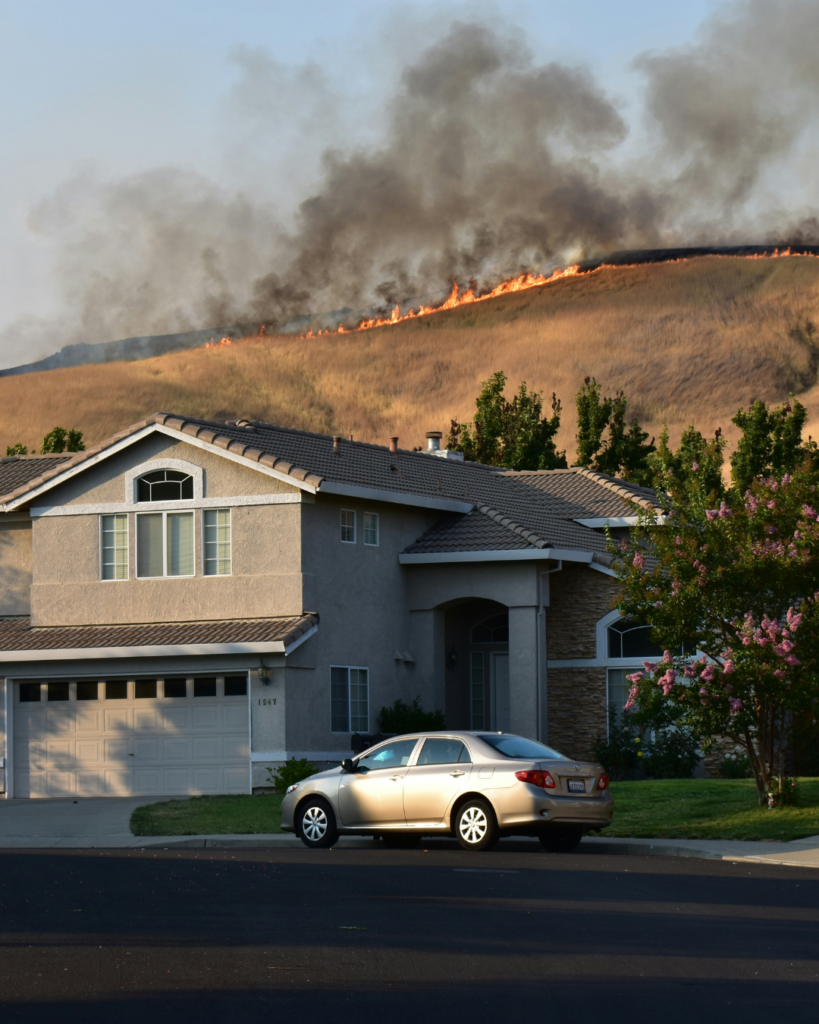
Every summer, Bay Area communities face the growing risk of wildfire. Creating defensible space around homes and neighborhoods is an important part of protecting people, pets, wildlife, and entire ecosystems from devastating fires.
At the same time, spring and summer are also critical nesting and baby wildlife seasons throughout California. Thoughtful planning and timing can help reduce wildfire risk while minimizing impacts to local wildlife families.
WildCare fully supports responsible wildfire preparedness efforts and encourages residents to approach vegetation management in ways that help protect both community safety and the natural world we share.
PLAN AHEAD
Whenever possible, major pruning, tree removal, and vegetation clearing are best completed between November and February. This timing helps reduce disturbance to nesting birds and baby wildlife during peak breeding season.
Because wildfire preparedness remains important year-round, ongoing maintenance during the summer may still be necessary as grasses dry and vegetation regrows. WildCare encourages residents to use wildlife-aware practices whenever possible while maintaining defensible space around their homes.
WildCare typically admits the highest number of orphaned baby animals between April and August, though baby wildlife may be present as early as January and as late as November depending on species and weather conditions.
START CLOSEST TO HOME
One of the most effective ways to reduce wildfire risk while minimizing impacts to wildlife is to focus first on the area closest to your home.
Maintaining defensible space in “Zone Zero” — the first five feet surrounding a structure — and improving ember resistance through home hardening measures can significantly improve wildfire safety while reducing the need for large-scale vegetation removal.
This “house-out” approach prioritizes the areas closest to structures first and is considered one of the most effective ways to improve fire safety while helping preserve surrounding habitat.
CHECK FOR WILDLIFE BEFORE YOU WORK
Before trimming trees, clearing brush, or removing vegetation:
✅ Look carefully for nests, burrows, dens, or active wildlife
✅ Watch for fledgling birds on the ground nearby
✅ Check shrubs and trees thoroughly before pruning
✅ Delay work if active nests or baby wildlife are present whenever safely possible
✅ Keep pets away from active work areas
If you are unsure whether wildlife may be present, please contact WildCare’s Wildlife Hotline before beginning work.
📞 Wildlife Hotline: 415-456-7283
Hummingbirds and other small wildlife can be surprisingly hard to spot
in dense branches. Always check carefully before trimming vegetation.
Resources for Wildfire Preparedness from Fire Safe Marin and Other Groups
The resources below pertain primarily to WildCare’s county of Marin and the San Francisco Bay Area.
If you live outside this region, please check with your local Fire Department for resources specific to your area. Need additional resources? The National Fire Protection Agency (NFPA) is a good place to start.
Your Title Goes Here
Homeowner's Guide to Wildfire Preparedness in Marin County (Fire Safe Marin)
Fire Smart Landscaping Guide Book
How to Create a Fire-smart Landscape (UC Marin Master Gardners)
Planning a Fire Smart Landscape
UC Marin Master Gardners provides information on planning and maintaining fire smart landscaping.
How to Protect Birds Prior to Removing Flammable Vegetation (Fire Safe Marin)
How to Survey and What to Look For
Fire Safe Marin.
Creating a fire-resilient landscape (UC ANR Fire Network)
Preparing Home Landscaping
Fires require fuel to spread, and any combustible materials, including vegetation, wooden fences, or sheds can serve as fuel. Once ignited, these materials can create a direct fire path toward a house. There can be both horizontal and vertical paths. The risk of fire spreading to your house can be significantly reduced by removing these potential fire paths.
Check for nesting wildlife
Look for signs of nesting wildlife before trimming trees or clearing brush. See dropdowns for species-specific information.
If you spot nests or active wildlife, avoid those areas and call WildCare for guidance at 415-456-7283.
How to Tell If Songbirds Are Nesting
In Northern California, most bird species nest through spring and summer, but watch for hummingbird nests as early as February!
How do you know that nest is present?
You can start by looking carefully for nests, but this is NOT a foolproof method! This photo shows how tiny and well-camouflaged a hummingbird’s nest is. This branch was cut from the tree, even after a careful inspection had been completed.
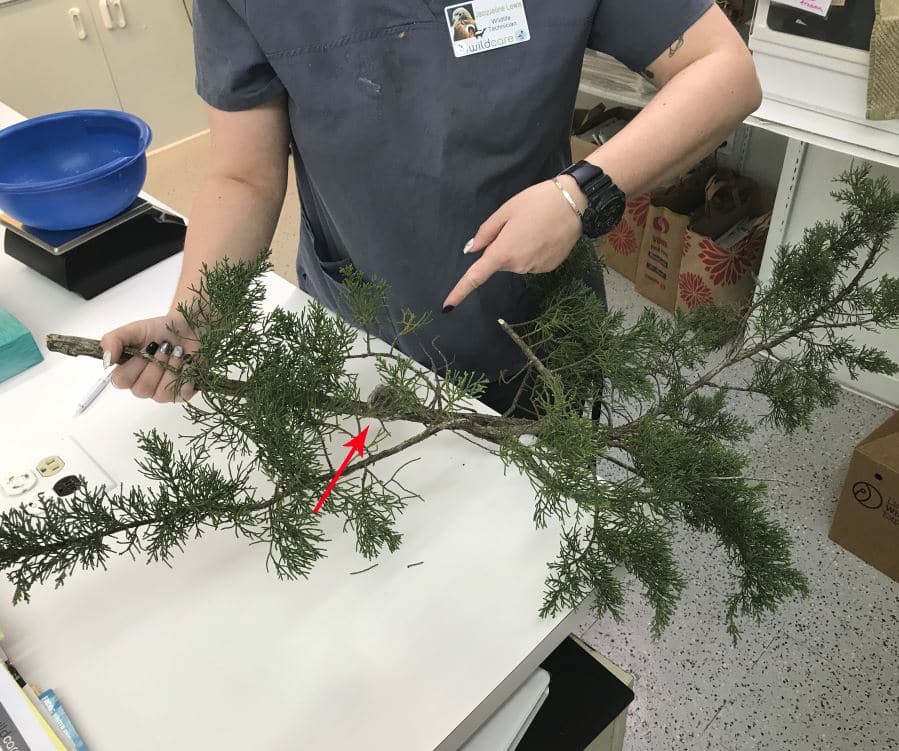
Birds camouflage their nests carefully and deliberately. Watch for the activity of adult birds to indicate a nest’s presence, but remember that parent birds are very anxious to protect their young and they will often enter and exit the nest quickly.
Look for birds entering and leaving the tree or shrub at the same spot to indicate the approximate location of a nest.
A female hummingbird may buzz and dive toward you aggressively, in which case you should consider yourself warned of the presence of a nest. But even without overt indications of a nest, or visible confirmation, remain extremely vigilant while working in trees or bushes. It is not uncommon for female birds to sit on the nest for extended periods, giving no indication of their presence.
Having an extra pair of eyes on the ground is helpful to avoid disturbing nests. Garden, trim and prune with a partner so someone is always paying attention to the movements and potential aggravation of adult animals, indicating the presence of babies.
Remember that disturbing a nesting wild family can disrupt caretaking and have long-term consequences for the growing young animals.
Please delay non-emergency tree work and pruning until after the young have fledged, ideally waiting until November.
If birds are nesting in an area of your garden or a tree that needs work, call WildCare’s advice line (415-456-7283).
Birds are federally protected, (including nests that are occupied by eggs or babies), and we can help you determine which species is in residence, and tell you how soon the babies will fledge and leave the nest.
The good news is that most birds fledge very quickly. In most cases, simply being patient for a couple of weeks is all it takes before you can safely (and legally) remove the nest.
House Finches provide a good example of the process.
These birds tend to nest in precarious places close to our living quarters: on top of porch lamps, in hanging flowerpots or in outdoor wreaths.
The mother incubates her eggs for 11 to 14 days. Enjoy watching the babies grow for about two weeks, and you’ll ultimately see these little youngsters leave the nest.
If you want to do some work in the area of a House Finch’s nest, remove it as soon as the babies have gone; House Finches will reuse the nest for a second family soon after the first clutch fledges!
Most bird species (other than House Finches) won’t use the nest again this year once all the babies have left. This means you can safely remove it and reclaim your property.
Keep your cats indoors for a week or so, to give the fledglings time to get the hang of this flying business! (Better yet, keep kitty indoors all the time for her safety as well as theirs!)
Quick Review of Bird Family Life
Most birds have their own territories. Even if their nest has been destroyed and their babies have disappeared, parent birds will remain in their home territory, often searching for their babies for up to two days.
Nestlings are helpless, featherless or pin-feathered birds that cannot keep themselves warm. Always pick up a nestling baby bird and keep him or her warm while you call WildCare 415-456-7283. Despite what we may have learned as children, parent birds will NOT reject their babies just because they have been handled by humans.
WildCare reunites dozens of baby birds with their parents every year. As long as the baby birds are warm and healthy, the parents will accept them back into the nest. However, because nestlings cannot yet regulate their body temperature, they are extremely prone to hypothermia. Just assume that a nestling baby bird on the ground needs immediate help and warmth
Fledglings are slightly older birds with feathers and short tails. They can perch, hop or walk.
Birds at this age are learning to fly, and may live on the ground for as long as two weeks while developing their flying skills. Unless they are injured, or in immediate danger from humans or other predators, they are best left where they are.
A fledgling’s parents continue to feed him until he learns to fly and is able to find food. Sometimes this takes a while. Swallows, for example, have to learn to snatch insects from the air in mid-flight. Can you imagine how much practice that takes?
Parents will guide their fledglings into bushes at night to hide from predators, but will not come to their babies if you or your pets are nearby.
How to Tell If Squirrels Are Nesting
Squirrels nest in cavities (holes) in trees, or they build nests called dreys, which look like large clumps of leaves instead of the carefully-constructed nurseries that they actually are.
When building a drey, a squirrel will choose a juncture of two branches to support the drey, and begin by weaving together green twigs and branches as a base to support the nest. Building up layers of insulative materials is next, and finally an outer skeleton of branches, leaves and sometimes vines is added for additional structure and waterproofing.
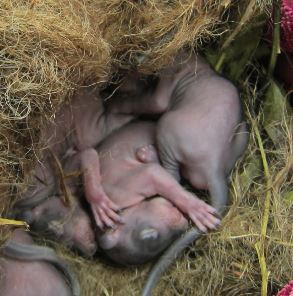
The interior of the nest is soft and warm, the perfect place to give birth to tiny, hairless, helpless baby squirrels.
The construction of a nest in a tree cavity is similar, with soft, warm material lining the interior.
How to Identify a Squirrel’s Nest
Although squirrels take care to camouflage their nests, you can identify a drey with some careful observation.
It can be challenging to find a nest in a cavity, but look for a clump of leaves in a Y juncture of branches fairly high in the tree. Dreys are spherical (globe-shaped) and usually measure a foot to two feet in diameter.
In a leafy tree, a drey can be challenging to spot, but note that the leaves from which the drey is constructed will usually be brown, in contrast with the green foliage of the living branches around it.
Mother squirrels plan ahead, and a mother may have four or five different nest sites built in her territory. Especially when her babies are newborn, the mother squirrel won’t leave the nest very often, so don’t expect squirrel activity to alert you to the presence of an active nest.
Assume any drey you spot between March and October is an active drey, and refrain from tree trimming until winter.
Squirrel Family Life
The gestation period for Western and Eastern Gray Squirrels is 43 and 44 days respectively. The babies are born hairless and helpless, with eyes and ears tightly sealed shut.
The babies’ ears lift up from their skulls at about three weeks or age, and their eyes open at approximately 4 weeks old.
The mother squirrel nurses her young for about 10 weeks, but the curious youngsters will start playing outside the nest at approximately 5 weeks of age.
Watch your trees for uncoordinated baby squirrels who are just learning to climb, and call WildCare if you see one fall 415-456-7283.
How to Tell If Raptors Are Nesting
It’s not just songbirds that become victims of tree trimming! Larger birds like raptors can also be orphaned by tree work.
The nests of cavity-nesting raptors like Western Screech Owls can be difficult to spot. Assume that any hole in a tree is likely to be the nesting hole for an animal of some kind.
Natural cavities in trees are incredibly desirable nesting sites, and they’re hard to find. If you have a tree with natural holes that you hope to remove, please leave it in place throughout wildlife baby season (March – October in Northern California). And actually, please consider having the tree safety-pruned instead of removing it, so as to offer valuable nesting sites in future years too.
Raptor nests that aren’t in cavities seem like they would be easy to spot because they’re large, but it can be surprisingly challenging to pick out a nest from the foliage surrounding it. Hawks and owls nest high in trees, and the birds build their nests to offer protection to their young from both ground-based and air-based predators.
The best way to tell that you have a raptor nest in your tree is to look for “whitewash” from the birds’ droppings.
Both parent and baby hawks and owls will defecate over the edge of the nest to help keep it clean. This often leaves a tell-tale splatter on the branches, trunk and ground under the nest.
While not all raptor nests will show “whitewash,” this can be an effective way to tell if you have nesting raptor neighbors.
Another method is to listen and observe. Many raptors are fairly noisy (especially Red-shouldered Hawks!) and hungry baby hawks make a lot of noise when they beg.
Watch for adult raptors circling your trees, and listen for begging calls to determine if young are present.
When to Rescue (Know the 5 Cs)
Never hesitate to rescue a baby bird that needs it! Call WildCare’s Hotline at 415-456-7283 for advice.
It is a MYTH that parent birds will not accept their baby back if he or she has been touch by a human. Birds will absolutely accept a fallen baby back into the nest!
They will even accept and care for orphaned baby birds of the same age and species as their own nestlings.
However, parent birds will not tend to more than one nest, and attempting to replace a missing nest often fails.
If a nest or baby animal has been cut from a tree, the likelihood of injury is high. Assume that any baby animal involved in a tree-trimming accident needs to come to WildCare, and always call before attempting to replace or substitute a nest.
There are other situations that also always require rescue. Naked nestlings and baby birds still covered in downy fluff need immediate care. Keep a naked or fluffy baby warm and call WildCare immediately if you find one on the ground.
If a fledgling (feathered) baby bird has not been involved in a tree-trimming accident, but you’re concerned she has been abandoned, watch for the parents. Observe the baby continuously for 60-90 minutes from a distance of about 50 feet. Remain quiet, out of sight, and keep children and pets away from the area. Watch carefully; the parents fly in and out quickly.
If you have a rescued bird in a box, check the feces. Clear droppings with white or green bile indicates a baby bird is not being fed and is likely orphaned. Color in the feces indicates that the the baby has eaten recently, and you may be able to return the baby to her parent’s care if the original nest has not been disturbed. Call WildCare to confirm at 415-456-7283.
How do you know if a wild animal of any species needs your help? The Five Cs!
The first things to look for if you think a wild animal of any age needs rescue are the Five Cs. If an animal demonstrates any of these five symptoms, it is an emergency and he needs immediate help:
1. Is he Crying?
2. Is he Cold?
3. Is he Coming toward you (approaching people)?
4. Is he Covered with blood or insects?
5. Has he been Caught by a cat or a dog?
If the answer to any of these questions is yes, immediately call WildCare’s Hotline at 415-456-7283 for assistance and advice.
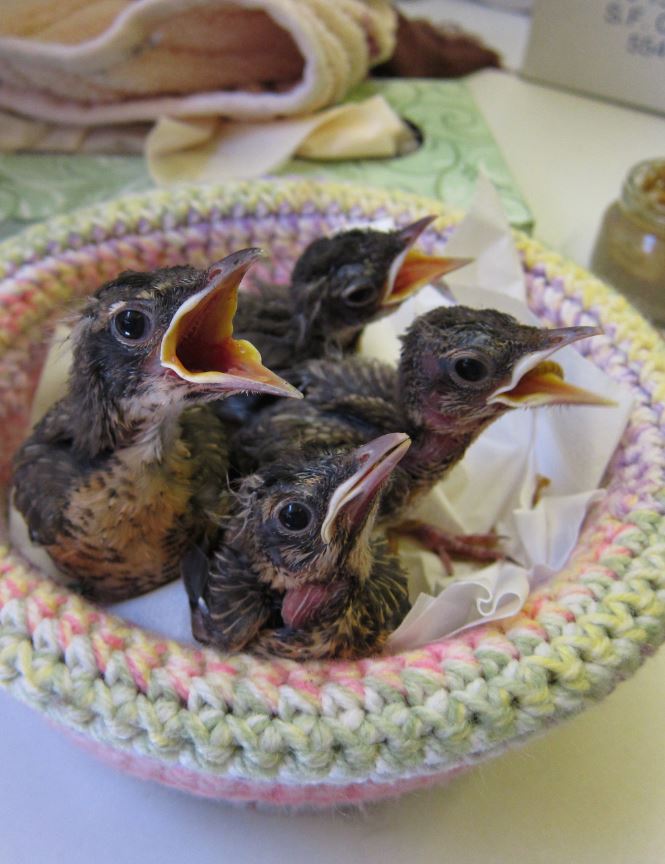
Baby robins. Photo: Alison Hermance