
Have you ever seen an American badger? Most people never have. Although they inhabit many areas around the San Francisco Bay, these remarkable animals are fierce, solitary, and almost entirely nocturnal — living in deep dens they dig with their powerful claws, rarely crossing paths with humans.
That’s what made it so alarming when rescuers in Point Reyes National Seashore spotted a young badger lying injured on the road.
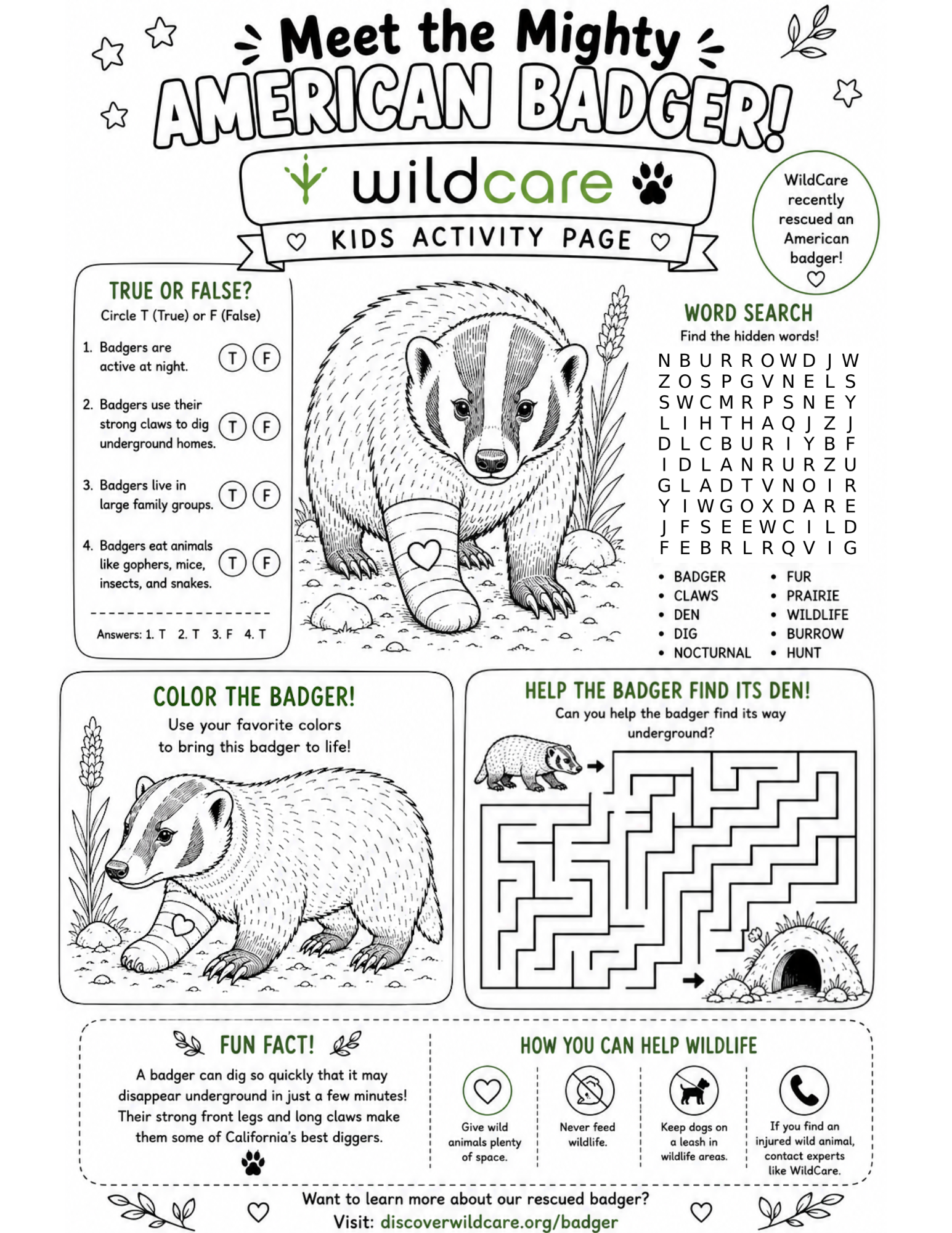
Free Printable Badger Activity Sheet for Kids
Celebrate our badger’s journey home with a free printable activity sheet for kids. Color, solve a maze, and learn fun facts, then try digging like a badger yourself!
A Rare and Critical Patient
He had been struck by a vehicle. National Park Service Law Enforcement Officers responded to the call and carefully maneuvered him into a carrier for transport to WildCare’s wildlife hospital.
This young male was only the third badger admitted to WildCare in ten years! Our medical team prepared themselves accordingly. Badgers, who are apex predators, have ferocious attitudes, powerful builds, and a bite to match. Handling one is not for the faint of heart.
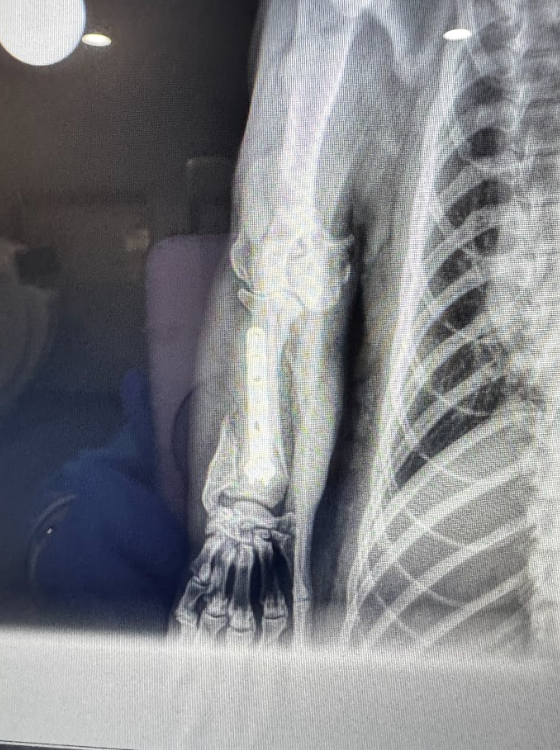
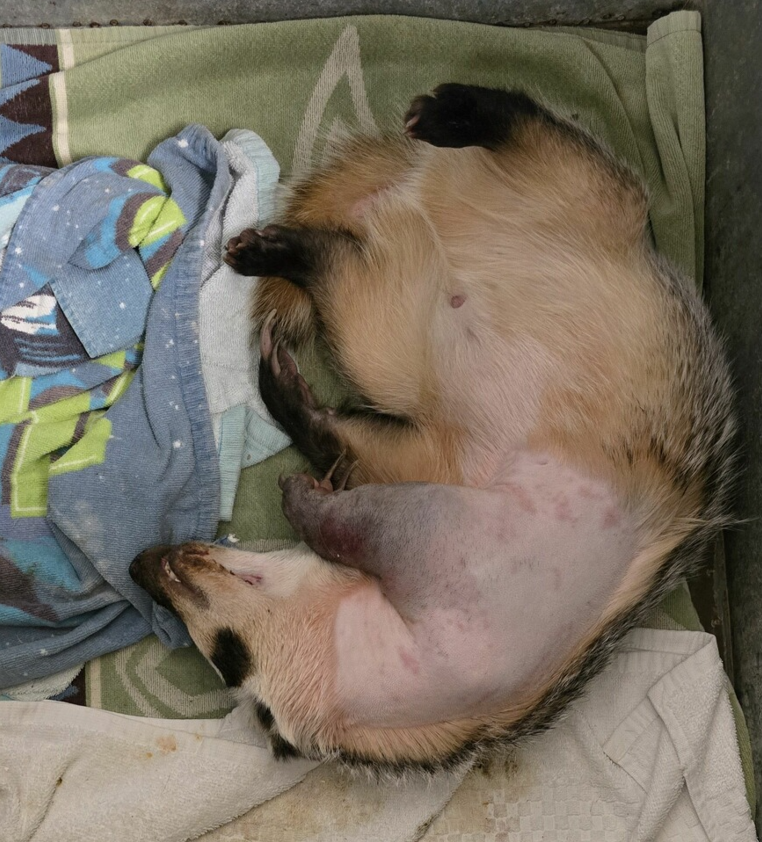
On intake, he was clearly disoriented and in pain. The team immediately sedated him, administered pain medication, antibiotics and fluids, and took radiographs. The results confirmed serious injuries: fractures to the radius and ulna of his right forelimb, a broken upper canine tooth and multiple puncture wounds on his chin, likely from his own powerful claws if he had been tumbled by the impact. His prognosis was guarded.
There was one encouraging sign, though. Despite everything, he was well-fed, had a healthy coat and showed no signs of parasites. This was a strong, young animal. Our team was determined to give him every chance.
The Challenge of Keeping a Badger in a Cast
The first step was stabilizing the fractured limb with a temporary cast while the team searched for a veterinary orthopedic specialist willing to take on the repair. Badgers rely on the extraordinary strength of their front limbs to dig, hunt, and survive. Anything less than a full recovery would mean he could never be released.
Keeping the cast on, however, proved to be another matter entirely. Badgers are simply too strong, and too persistent. It quickly became clear that casting alone wasn’t going to work. Only surgery would give him a real shot.
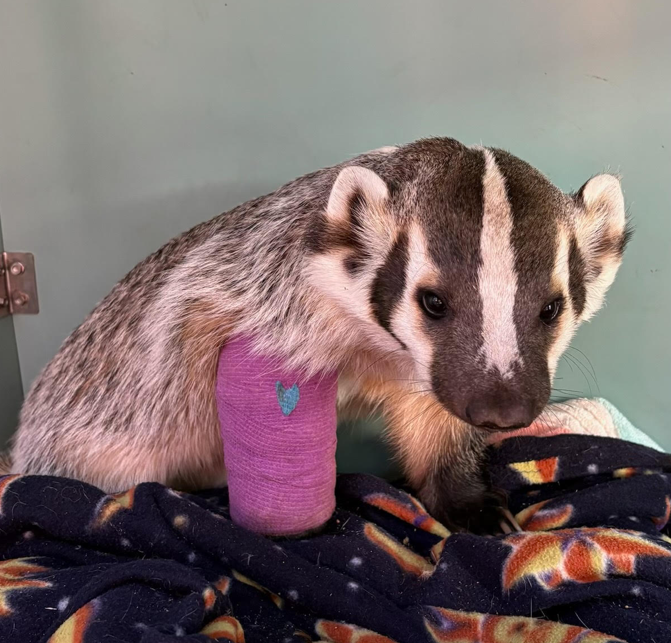
Badger with temporary cast at WildCare prior to surgery.
An 8-Hour Surgery
WildCare reached out to orthopedic specialists across the Bay Area, and Dr. Kayla Caturay, DVM, Surgery Resident at Lenity Vet Specialists & Emergency Care in San Mateo agreed to take on the challenge.

Dr. Kayla Caturay, DVM, Surgery Resident at
Lenity Vet Specialists & Emergency Care in San Mateo

Dr. Maria Glowaski, DVM, anesthesiology
What followed was a grueling procedure. Dr. Caturay and anesthesiologist Dr. Maria Glowaski, DVM worked to align the fractured bone fragments – no easy task given the badger’s powerfully developed musculature. After eight hours in surgery, Dr. Caturay had successfully reduced the fractures and secured them with a titanium plate, closing the incision in three careful layers to reduce the chance of the badger interfering with it.

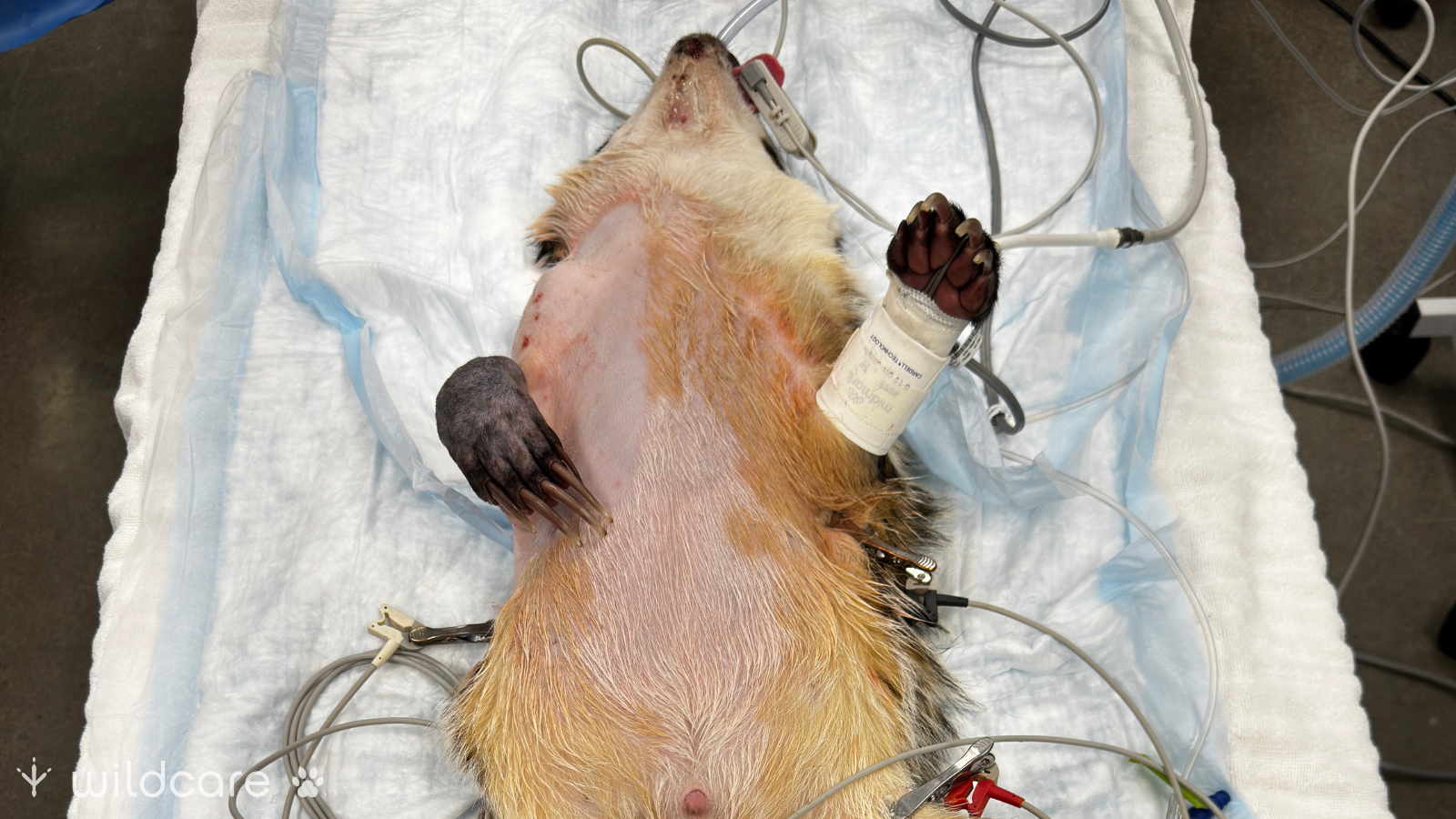
Despite generous discounts from the surgical team, the procedure came to just over $10,000, a testament to its complexity and to the remarkable commitment of everyone involved.
Life on Cage Rest (Or: The Pipe Incident)
The surgeon ordered ten days of cage rest with limited mobility. However, keeping an apex predator still for ten days is, as you might imagine, a tall order.
The first obstacle, finding a badger-accepted den. The team placed him in WildCare’s most spacious indoor enclosure and provided a cat carrier as a den-like retreat. He dismantled it immediately. They replaced it. He dismantled that one too. And the next. Three carriers later, Dr. Sorem had a new idea: one of the large, heavy corrugated plastic pipes used for enrichment with other wildlife patients.
A few minutes after it was placed in his enclosure, the team heard a rhythmic knocking sound from the ward. They checked the camera to find the badger contentedly rocking the pipe back and forth, gently rocking himself. Apparently, he had found his comfort object.
He recovered well from surgery and, to the team’s relief, left his incision completely alone.
A Second Surgery: Dental Care for the Wild
A few weeks into his recovery, the badger headed off for a second procedure. Dr. Milinda Lommer, DVM, DAVDC at Aggie Animal Dental Care performed an extraction of the broken upper right canine, a step that was critical to preventing infection and ensuring he could hunt and forage properly once back in the wild. Dr. Lommer and her team generously donated the $1,500 surgery, a gesture of extraordinary kindness the WildCare team will not forget.

Dr. Milinda Lommer, DVM, DAVDC
at Aggie Animal Dental Care
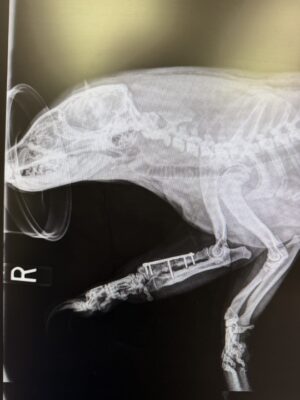
X-ray of badger canine tooth
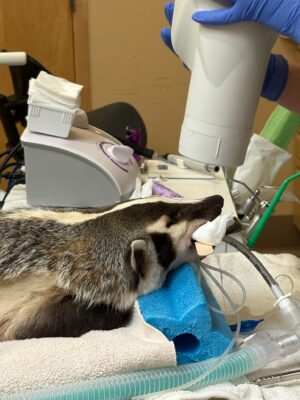
Badger receiving oral surgery
Recovery: From Limp to Den-Digger
Once off medications and visibly restless, it was time to move him to a large outdoor enclosure — the kind built specifically for powerful, aggressive patients like badgers, bobcats, and coyotes. A custom den box with a sliding door gave him a safe place to sleep. Branches, logs, and large tubs of dirt gave him something to do.
WildCare staff monitored his progress via remote cameras. In the early weeks, he walked with a severe limp, barely putting weight on his repaired leg. But week by week, the change was undeniable. He began using the leg more. Then he started rearranging the logs and potted plants in his enclosure — every single night. Then came the dens, dug with the full force of those remarkable forelimbs.
He was back.

A Historic Release
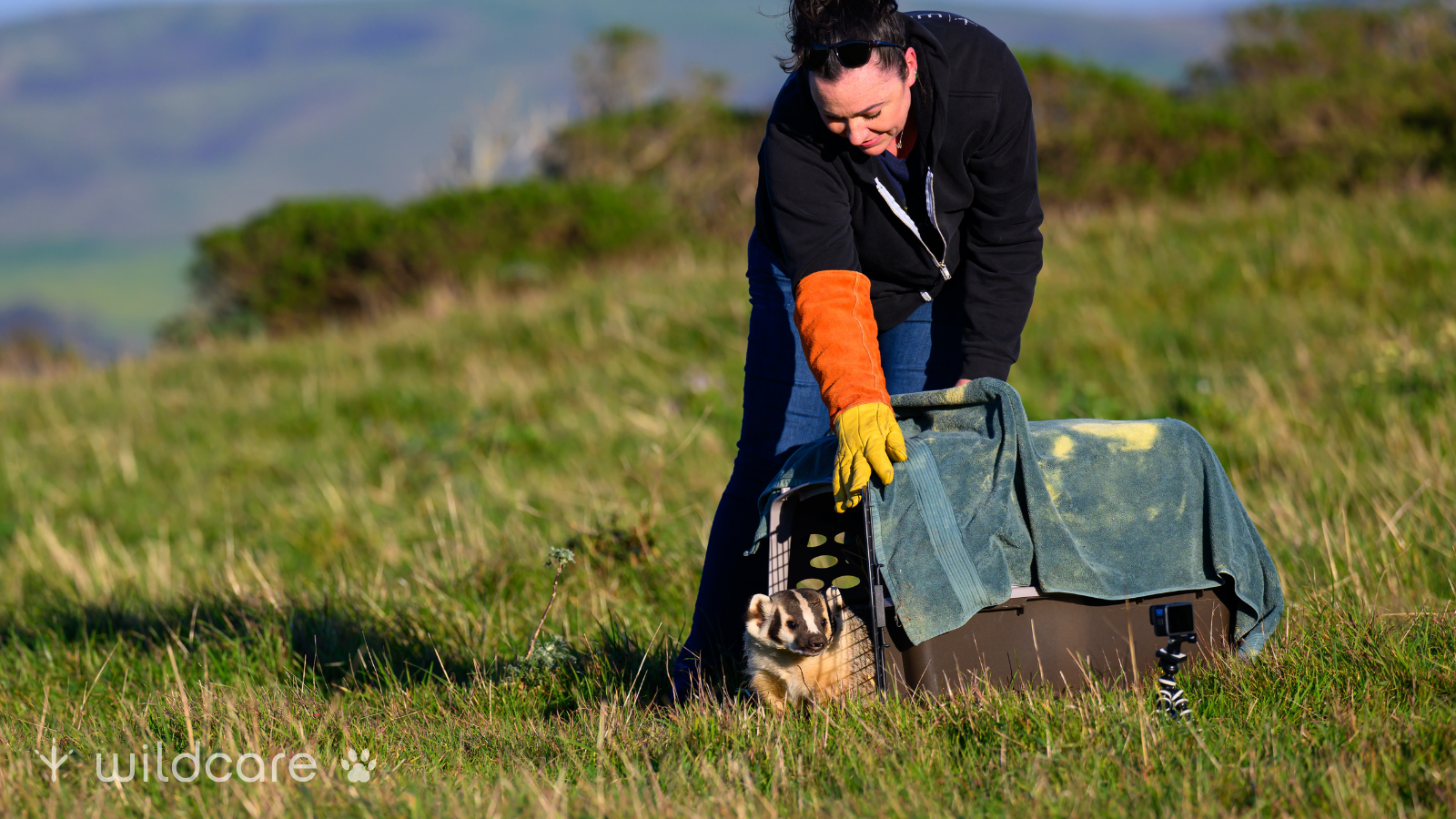
After 102 days in care, and in collaboration with the California Department of Fish and Wildlife, the young badger was cleared for release. This special release was a team effort with many invested parties. WildCare staff, NPS rangers, biologists, and the original rescuers all gathered in Point Reyes to set this badger free. Releasing such a rare and resilient patient after months of intensive rehabilitation was an incredibly rewarding experience for everyone involved.
As confirmed through WildCare’s partnership with the California Department of Fish and Wildlife, this is believed to be the first known instance of a wild badger receiving major orthopedic surgery and being successfully released back into the wild. The Department plans to use this outcome as a benchmark for future badger cases across California and potentially nationally.

Why It Matters
This case didn’t just save one animal. It expanded what’s possible for every badger and every complex wildlife patient that comes after him. This is only possible because of the generosity of WildCare’s supporters, who make it possible to say yes to pushing the boundaries of rehabilitation, and the dedication of the specialists and partners who gave so much of their time and expertise.
Thank You
WildCare extends deep gratitude to:
- Dr. Kayla Caturay, DVM, Surgery Resident and Dr. Maria Glowaski, DVM at Lenity Vet Specialists & Emergency Care for an extraordinary surgical effort
- Dr. Milinda Lommer, DVM, DAVDC at Aggie Animal Dental Care for generously donating the dental surgery
- NPS Rangers and Biologists at Point Reyes for their partnership from rescue to release
- The California Department of Fish and Wildlife for their collaboration on this landmark case
- WildCare’s supporters, whose donations make it possible to say yes
If you find an injured or orphaned wild animal in the Bay Area, please contact WildCare immediately at 415-456-7283. Never attempt to care for a wild animal on your own – our trained staff are here to help. Learn more and support our work at discoverwildcare.org.
WildCare is a 501(c)(3) nonprofit wildlife hospital and nature education center based in San Rafael, CA. We rescue and rehabilitate over 4,000 wild animals from 200+ species each year.