
Found injured on the Side of the Road
Have you ever seen an American Badger? Most people would say no!
Although they inhabit many areas around the San Francisco Bay, these incredible animals are fierce and reclusive. They live in deep dens they dig with their powerful paws and claws, they’re solitary most of the year, and they’re primarily nocturnal, so it’s very unusual to see one.
Rescuers in Point Reyes National Seashore were surprised when they spotted this young badger lying on the road, clearly injured. The best guess is that he was hit by a car. National Park Law Enforcement Officers, some of the few NPS staff who weren’t furloughed during the government shutdown, responded to the rescuers’ call and succeeded in maneuvering the badger into a cat carrier for transport to WildCare’s Wildlife Hospital.
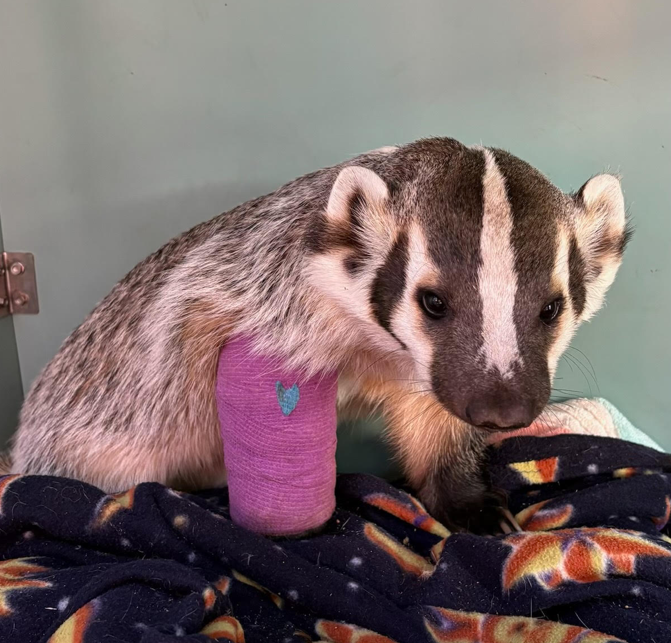
Badger with temporary cast at WildCare prior to surgery.
Upon hearing that a badger was on his way, Medical Staff prepared to admit an animal with a ferocious attitude, and the powerful strength, sharp teeth, and incredibly powerful bite to match. Handling badgers is not for the faint of heart!
On intake, the young badger was clearly disoriented and in pain, so the the team immediately sedated him to relieve his distress and allow them to do a full examination, administer pain medication, antibiotics, and subcutaneous fluids and take radiographs (x-rays).
The badger’s intake exam revealed that he had a broken radius and ulna, the two bones in his right foreleg. He also had multiple puncture wounds in his chin, which may have come from his own massive claws if he was tumbled when the vehicle hit him, and a broken tooth.
Overall the young animal appeared to be in good health with a luxuriant coat, good weight, and no fleas or ticks, which boded well for his eventual recovery. The next morning, the badger was clearly feeling better! Watch him in the video below enjoying a hearty meal.
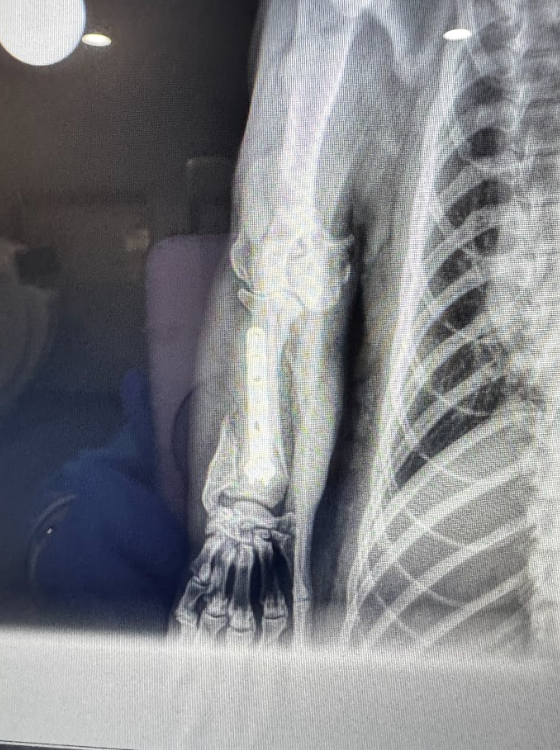
WildCare’s Veterinarian Dr. Sorem, placed a temporary cast on the badger’s foreleg while the team reached out to veterinary orthopedic specialists around the Bay Area in search of a surgeon who could take on the challenging repair of the broken radius and ulna.
Badgers rely on their strength to survive, so we knew this young badger needed his foreleg to be 100% before we could release him back to the wild. Fortunately, the skilled orthopedic surgeons at Lenity Veterinary Specialists in San Mateo responded to the call.

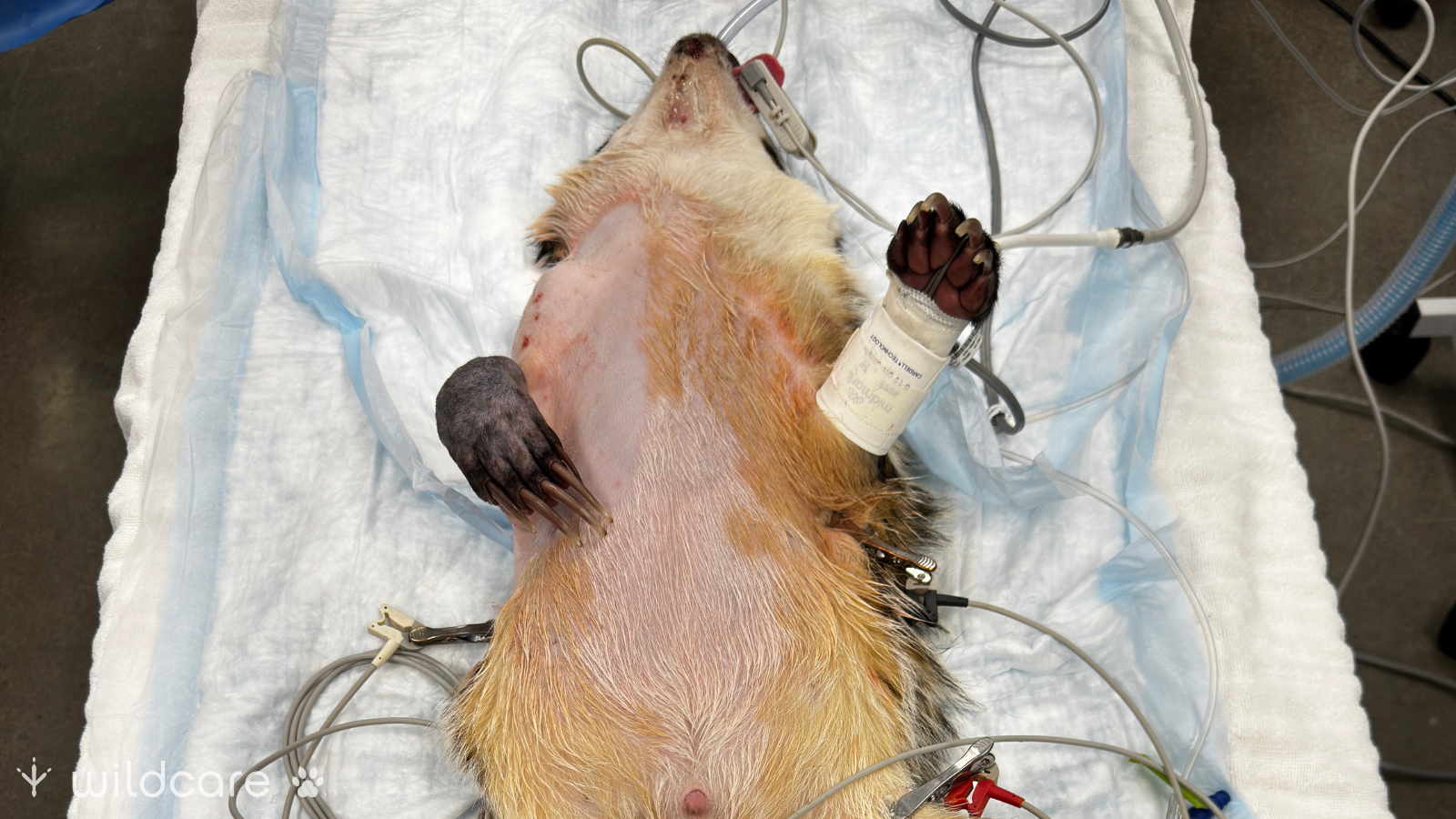
Dr. Sorem reported:
“At Lenity, surgeon Dr. Kayla Caturay and anesthesiologist Dr. Maria Glowaski undertook a grueling 6-hour procedure to repair the fracture. The well-developed musculature of the badger’s forelimbs made alignment of the fracture fragments challenging, but Dr. Caturay persisted and was able to reduce the fractures and secure them in place using a titanium plate. After the hours-long surgery, she closed the surgical incision in three separate layers with no external sutures to reduce the possibility that the badger would open it back up during his badger activities.”
“The badger recovered quickly from anesthesia and actually dug into his dinner as soon as he returned to WildCare late that evening. He has left the surgical incision alone and has begun using his right forepaw to manipulate food and objects.”
In WildCare’s Wildlife Hospital, the badger has charmed everyone who watches his monitoring camera with his antics. His surgeon ordered that he remain confined on “cage rest” with limited mobility for 10 days, but keeping a wild animal, especially an apex predator like an American Badger, still and resting for so many days is a tall order.
The team placed the badger in our most spacious indoor enclosure, and they first attempted to put in a cat kennel to provide him with a den-like space to hide and rest in privacy, but in his boredom he easily dismantled the carrier. He ultimately tore through three carriers while the team looked for another alternative. Then, Dr. Sorem had the brilliant idea to give the badger one of the heavy black plastic corrugated pipes we provide for enrichment for other wildlife patients. A few minutes later, she and the team were curious to hear a repetitive knocking sound coming from the ward containing the badger. Apparently the young animal enjoyed the sensation of rocking the pipe back and forth, and the team frequently checked the camera to find him sprawled out, on his chest or even on his back, rocking himself gently.
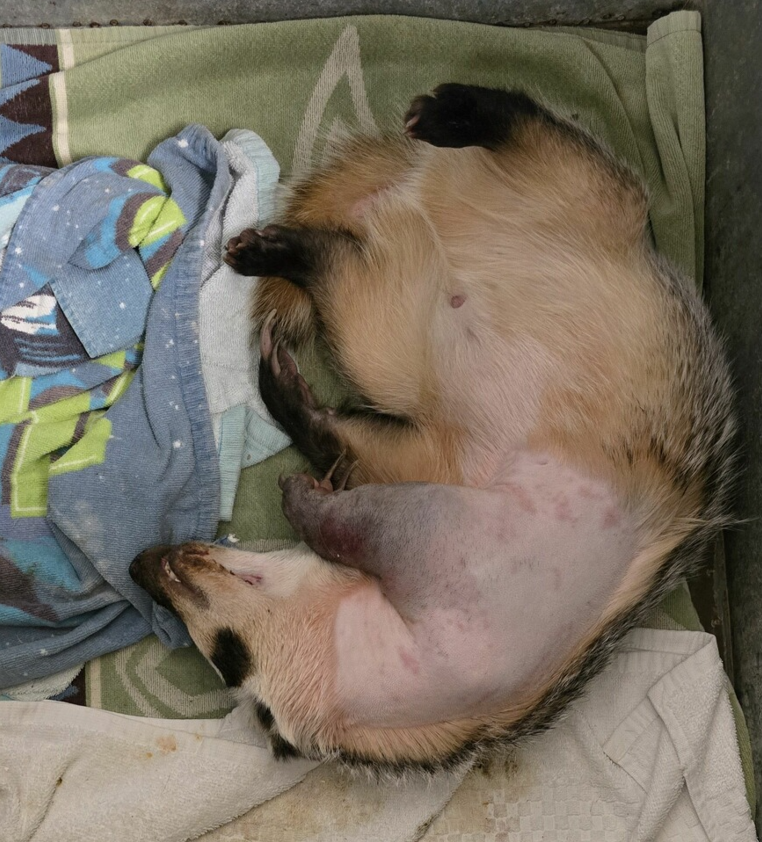
The badger is recovering well in care. In this photo of him sleeping, you can see his plump and well-fed belly, as well as his surgery-shaved foreleg. Badgers have no real predators in the wild, and this young badger clearly feels comfortable enough at WildCare, despite the unconventional accommodations, to sleep with his belly exposed.
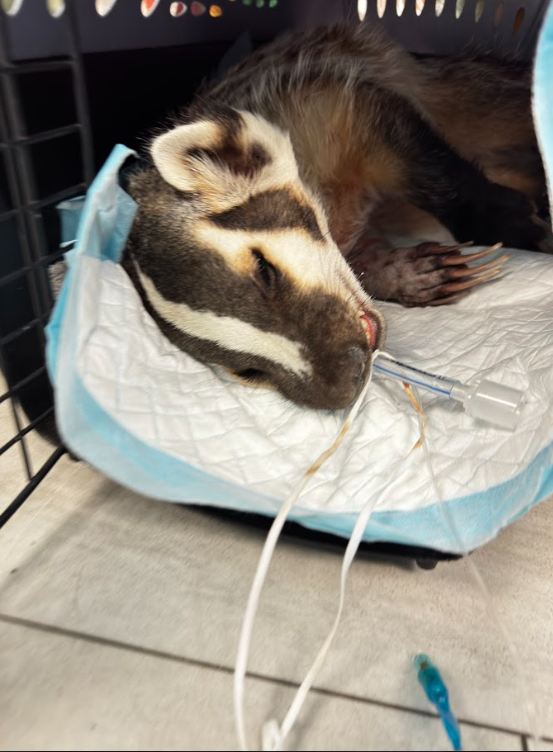
As the days passed, the badger became increasingly restless, aggressive and bored in his small indoor enclosure! Once we had reached the end of the doctor-mandated 10 days of cage rest, the team was able to set up a large outdoor enclosure full of enrichment items to contain the badger and hopefully keep him occupied well enough to heal completely. You can see him making his initial tour of the space in the video.
A custom-made den box offers a safe place to sleep, and enrichment items including branches, logs, and several large tubs of dirt to satisfy his need to dig will hopefully keep him entertained as he continues his recuperation.
This enclosure was built for patients who are powerful and aggressive enough to pose a risk to staff when cleaning and feeding, like badgers, bobcats and coyotes. We’ve been using these enclosures a lot for different species, but this is the first time we’ve set it up with a den box that has a sliding door we can close to safely contain the animal while his enclosure is cleaned.
Over the next couple of months, several follow-up exams were conducted to guarantee that the badger was healing properly. Our staff kept a close eye on his behavior outside by utilizing remote cameras. In the beginning, he walked with a severe limp, not bearing any weight on that front leg. But over time, he eventually regained full strength, forcefully rearranged the potted plants and logs in his enclosure nightly, and dug numerous dens!

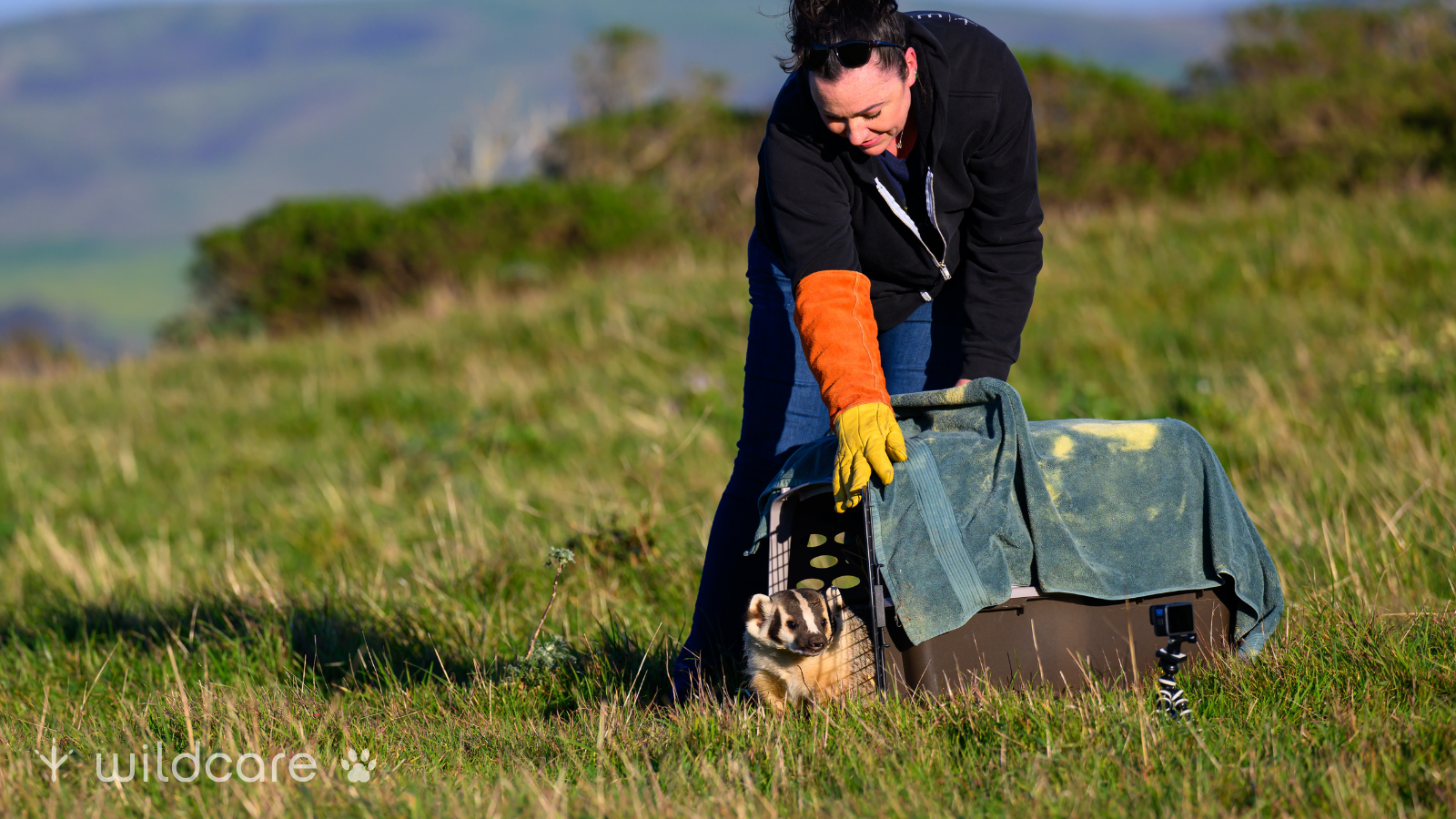
After 102 days in care, and in collaboration with the California Department of Fish and Wildlife, the young badger was cleared for release. This special release was a team effort with many invested parties. WildCare staff, NPS rangers, biologists, and the original rescuers all gathered in Point Reyes to set this badger free. Releasing such a rare and resilient patient after months of intensive rehabilitation was an incredibly rewarding experience for everyone involved.
As confirmed by our partnership with CA Department of Fish and Wildlife on this very unique case, this is believed to be the only known instance of a wild badger receiving such an orthopedic surgery and being able to be successfully released back into the wild! The Department plans to use this outcome as a benchmark for any future badger cases in the state.

We owe a huge thank you to Dr. Caturay, the dedicated NPS rangers and biologists at Point Reyes for their expertise and support throughout this case, and a special thank you to Dr.Lommer for generously donating the dental surgery!
We also owe a large debt of gratitude to our supporters, who make it possible for us to say ‘yes’ to responsibly pushing the boundaries of what’s assumed possible in patient treatment options, which in this case not only helped the individual, but stands to help save more badgers in the future across the state, and possibly nationally!
This badger’s journey back to the wild would not have been possible without such an incredible team effort!