
LIVING WITH WILDLIFE
Nuisance Wildlife Solutions
Living with Wildlife,
even when it’s hard
WildCare’s goal is to help people live well with wildlife, and all of our programs work together to help people navigate that boundary where humans and animals come into contact with each other.
When wildlife and people live together, there can be conflicts. Some animals may become a nuisance to you, something you might call a “pest.” WildCare believes in providing high quality care to every patient, no matter the species. However, we have created these “living with” guides to help you humanely live with all wildlife, even the “pesky” ones.
There are many simple, humane ways to solve animal problems.
Learn how you can share your environment with our wildlife without harm or conflict by using our “Living With” guides.
If you’re having a conflict with wildlife not covered here or have more questions, please call 415-456-SAVE to speak with our wildlife services representative.

Your Title Goes Here
Your content goes here. Edit or remove this text inline or in the module Content settings. You can also style every aspect of this content in the module Design settings and even apply custom CSS to this text in the module Advanced settings.
BARRIER TO PREVENT DIGGING ANIMALS
Installing this barrier properly will prevent digging animals from accessing this tempting den site. This method keeps out rats as well.
- Dig a trench around the deck, at least 12″ – 18″ deep (below ground level) and then attach ¼” wire mesh (hardware cloth) to the bottom of your deck.
2. Bend the mesh at a 90-degree angle away from the deck into an ‘L’ shape. Make sure you have 18″ – 24″ of mesh as the bottom of the ‘L’ making a false bottom that animals can’t dig through. This is the most important step!
3. Backfill with soil.
For a more attractive look, install lattice panels over the mesh.
Another method for excluding larger animals (skunks, raccoons, etc.) from under your deck or house is a product called Dig Defense. It is available online and at some hardware stores.

PREVENT BIRDS FROM HITTING WINDOWS
One of the main causes of migratory songbird mortality is window strikes.
The following steps can help reduce the number of birds killed by hitting windows, and a lot of lives could be saved if everyone implemented these strategies!
These suggestions come from FLAP Canada (Fatal Light Awareness Program). Visit their website at flap.org for excellent information on prevention of window strikes for homeowners and major metropolitan cities alike!
Window strikes can be reduced or prevented with the following steps:
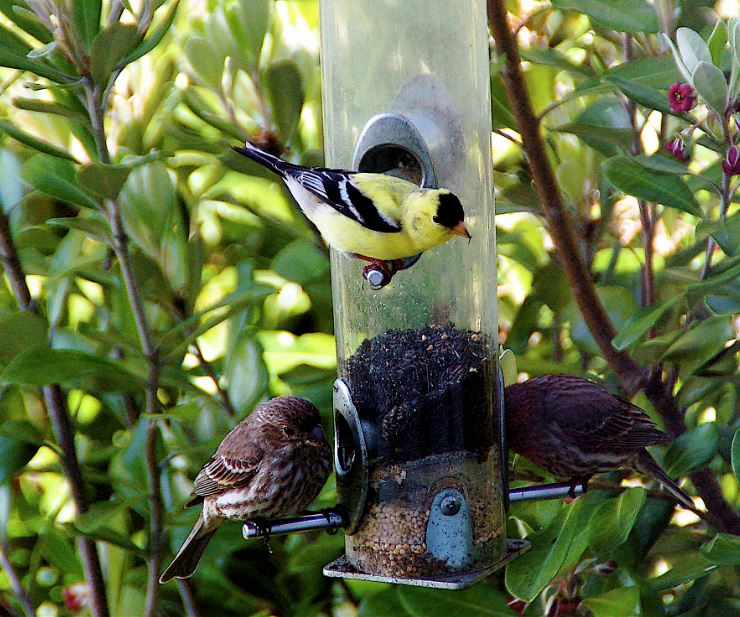
Photo by Eric Tymstra
Relocate your bird feeders
Position your bird feeders, birdbaths and other attractants half a meter (1.5 feet) or less from your windows.
From this short distance, birds cannot build up enough momentum to injure themselves should they hit your window. This may seem counter-intuitive, but the closer the bird feeder to your window, the better for the birds and your viewing!
Placing feeders 30 or more feet away from windows may also help.
Move houseplants
If you can see your houseplants from the outside of your home, then so can the birds. Birds perceive your houseplants as a possible perch or refuge. Moving your houseplants back from your windows lessens this attraction.
Close curtains and blinds
Close curtains and blinds to reduce the dangerous illusion of clear passage through windows, especially those that meet at corners, or where windows are situated in line with one another at the front and back of your home. Exterior window awnings can also help mute window reflection and help protect birds from the illusion of a clear passage.
Give the birds visual alerts
The key is to provide birds with the visual cues they need to alert them to the presence of glass. Visual markers on windows are the most effective collision reduction strategy when properly applied.
Unfortunately, one or two stickers on a window aren’t effective. To properly alert birds, windows must be covered with a uniform pattern four inches apart for vertical alerts, and five inches apart for horizontal alerts.
WindowAlert decals contain a component which brilliantly reflects ultraviolet sunlight. This ultraviolet light is invisible to humans, but glows like a stoplight for birds. In addition to the decals, you can also get UV liquid that you can paint on the outside of your windows. An application lasts up to three months, and is very effective for preventing bird strikes.
Always hang alerts on the exterior of the windows for best results.
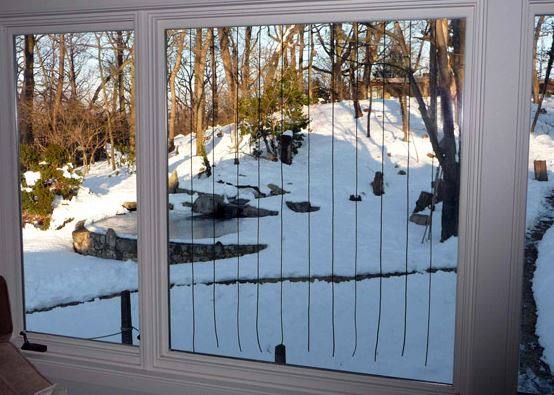
This photo shows a product called Acopian Bird Savers you can either purchase or make yourself. Spaced 4″ apart, a physical barrier like this can be a good visual alert to birds and, like a screen on the outside of the window, it also provides a visual barrier and softens the blow if a bird does fly into it. Learn more at birdsavers.com.
Please consider these steps to make your yard safer for songbirds! So many of the injuries WildCare’s songbird patients suffer are entirely preventable. With your help, more migratory songbirds will survive their arduous migration to sing another day.
Photo from Acopian Bird Savers website.
SAFELY FEED BACKYARD BIRDS
WildCare discourages the feeding of any wildlife. However, we recognize that millions of people love their bird feeders.
Feeders bring joy and enrichment to many people’s lives, and they can occasionally provide a valuable supplemental food source that improves bird survival.
However, poorly placed and maintained feeders may increase the risks of predation, window strikes and disease, so WildCare discourages bird feeding without total commitment to maintaining the health and safety of avian visitors.
Following the best practices below will help ensure that the birds that benefit from your feeder remain healthy and safe, to return again and again. WildCare’s Wildlife Hospital sees too many songbirds sick or injured from contact with careless humans. If you invite them with a feeder, please commit to the following steps to keep your songbird visitors safe.
Priority #1 – Cleanliness (bird feeders and bird baths)
Keeping feeders and the feeder area clean is of the utmost importance! A clean feeder will prevent unsightly messes, minimize attraction of unwanted visitors and help keep birds healthy.
When choosing a feeder, look for models that allow easy cleaning. Easy disassembly and removable parts are a plus, and metal and durable recycled plastic won’t split or crack as wood will, and are easily soaked in cleaning solution. WildCare does not recommend wooden feeders because they are difficult to disinfect thoroughly. Many saucer-style hummingbird feeders are even dishwasher friendly.
As the weather warms, please pay extra attention to hummingbird feeders!
The sugar solution in these feeders molds easily, and the mold can be harmful or even fatal to hummingbirds. Food should be changed every 1 – 2 days… if it is cloudy it has gone bad and needs to be removed immediately.
To properly clean hummingbird feeders: NO BLEACH! Change food often. Clean and fill with only enough to last 1-2 days (sooner if gets cloudy/moldy). Use vinegar and water in a 9:1 solution (9 parts water to 1 part vinegar) and special bottle brushes to get into small holes. Rinse thoroughly!
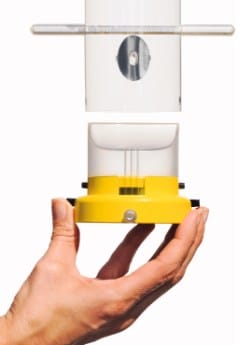
A good easy-to-clean feeder
Schedule regular maintenance of your bird feeders and bird baths following these steps to ensure healthy birds:
- Bird feeders should be disinfected every two weeks regardless of disease outbreaks.
- Bird baths should be emptied and cleaned daily regardless of disease outbreaks.
To properly clean bird feeders: Do not use wooden feeders. Immerse feeders in bleach solution (9 parts water to 1 part bleach.) Soak 10 minutes, scrub, rinse thoroughly and allow to dry fully before refilling (a dry feeder will deter mold growth on seeds).
To properly clean bird baths: You can make a 9:1 bleach solution in a jug to bring outside. Scrub with a hard brush, cover with board while soaking to prevent birds bathing in bleach, rinse very thoroughly, allow to dry before refilling.
Baths and other water sources should be emptied and refilled DAILY, and all water sources must be bleached (see above) weekly.
To properly clean hummingbird feeders: NO BLEACH! Change food often. Clean and fill with only enough to last 1-2 days (sooner if gets cloudy/moldy). Use vinegar and water in a 9:1 solution (9 parts water to 1 part vinegar) and special bottle brushes to get into small holes. Rinse thoroughly!
Wash hands thoroughly with soap and water after handling feeders or baths.
Additional Tips
- Always wear gloves (latex or dishwashing) to keep bleach off your skin and a facemask to keep from accidentally ingesting feces, bleach, etc.
- Always keep a large tray under feeder to collect hulls/seed that fall. Empty discards every evening. This will prevent mold & disease for ground-feeding birds and also prevent rodent infestations.
- Another suggestion to prevent wildlife problems (from rats, raccoons, skunks, etc.) is to bring feeders inside at night.
- Accumulation of fallen seed waste can be prevented by sweeping up regularly (if feeders are hanging over a hard surface, such as a patio), using a large tray underneath your feeder, or rotating your feeder among multiple locations. But perhaps the best way to address messy seed problems is by choosing the right kind of bird food.
- Good birdseed contains sunflower seeds and very little filler.
The Right Food
The primary ingredient in most quality wild bird seed blends is sunflower, which may appear either whole in its black shell or hulled to reduce mess and waste (sunflower “hearts” or “chips”). Sunflower is the most attractive seed for most perching songbirds, while white millet is attractive to ground-feeding birds such as sparrows, towhees, quail and doves. Often, seemingly inexpensive “wild bird seed” mixes are loaded with filler or near-filler grains that few songbirds will eat, leaving waste seed on the ground to sprout or attract rodents. Some ingredients to avoid are milo, wheat, sorghum, canary seed or anonymous “grain products.” Remember, look for sunflower!
Other foods will attract specific types of birds. Our beautiful, year-round goldfinches are attracted to a seed called Nyjer, or thistle. Hummingbirds enjoy a sugar water solution (4 parts water to 1 part sugar). Shelled peanuts or suet, both low-mess foods, will attract woodpeckers, jays, chickadees and more.
 Unwanted Visitors
Uneaten seed left on the ground will draw out local rodents. Eliminating seed on the ground around your feeder is the best way to avoid attracting rats and mice, and the animals that prey on rodents like raccoons and skunks. Often, these rodents are already resident in an area and are only made more visible by visits to bird feeders; other rodent magnets such as access to pet food or food waste, wood or brush piles, or thick patches of ivy should be removed. Uneaten seed will be greatly reduced by avoiding seed blends with filler ingredients and by regular clean-up as described above.
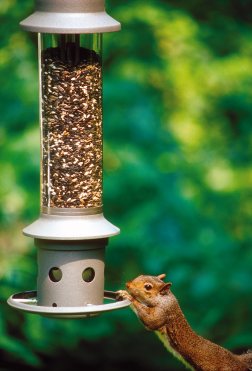
The second part of the solution is to ensure that only birds can access your feeders. Feeders hanging from a pole can often be protected with a baffle that prevents squirrels and rats from climbing up. Feeders hanging from trees can sometimes be protected by smooth dome baffles which protect feeders from above. Weight-sensitive feeders will close under the heavier weight of mammals and allow the greatest flexibility in placement.
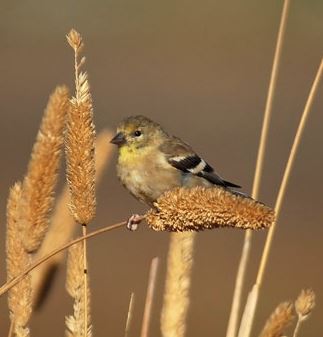
Goldfinch. Photo by Laura Milholland
Healthy Birds
Collisions with windows are one of the most frequent human-caused sources of songbird mortality. A poorly placed feeder, with no other precautions taken, can exacerbate this problem. When they sense a predator, birds will often flee a feeder without being too careful about where they’re heading. Keeping feeders 30 feet or more away from windows will help prevent this, while feeders extremely close (three feet or closer) to windows are generally also safe.
The most common songbird predators encountered around suburban yards are domestic and feral cats. More songbird patients are admitted to WildCare having been “caught by cat” than for any other reason. Place feeders high and above cats’ reach for greatest safety, be aware of cats in your yard, and remove feeders if they are attracting feline attention. Learn more about cats and their dangers to songbirds in the section “Songbirds, Cats & Catios”. For the birds, open visibility directly around the feeder is good, but having nearby trees and other cover is generally beneficial.
The best reason to clean feeders is to prevent the spread of sickness, just as humans clean shared cups, plates and utensils. The most common disease seen in our area is avian conjunctivitis, most frequently seen among House Finches. If you notice birds with swollen or closed eyes, take down and clean your feeders thoroughly, soaking them for a full 20 minutes in a 10% bleach solution. You should wait until you are no longer seeing afflicted birds before putting your feeders back up.
WildCare sees the bad effects of poorly-maintained bird feeders every day in the Wildlife Hospital and we would ask people to please use the information above. The right seed, and proper maintenance (and an eye out for the neighbor’s cat) will allow you to enjoy the birds that feeders bring your yard for years to come.
Written with Michael Gedney, Wild Birds Unlimited
Wild Birds Unlimited is a birdfeeding and nature store located in the Vintage Oaks Shopping Center in Novato. They have been featured in WildCare’s Local Heroes column and sell owl boxes. You can visit their website at wbu.com/marin or call the store at (415) 893-0500 to discuss your bird feeding questions.
LIVING WITH DEER
In many parts of the country, where deer are hunted, people rarely get to see them as closely as we do in the Bay Area. It is charming to see a mother and her fawn living their lives in the open spaces around us. It may not be quite as engaging, however, when they have just eaten all the flowers and buds off your prized rose bushes.
Living with deer is now a fact of our lives in the Bay Area. We eliminated their major predators, mountain lions, and now urban sprawl has crowded them into less and less space. This combination, along with fences, have made these foraging mammals a common sight in most neighborhoods, and overpopulation is a big problem.
Nowhere is this more apparent than in places surrounded by water like Angel Island and Belvedere. Population control in these places inspires heated debate over how to coexist humanely. This is happening in other places, too.
A Study of Birth Control on Deer
A study on the use of surgical sterilization of female deer* found that the ability to capture, chemically immobilize and perform surgery on wild deer, under field conditions, was highly successful.
The study showed that the population level goal of five deer per mile could be maintained over time if an average of 32% of the female deer were sterilized per year. Under these circumstances, long-term maintenance would require sterilizing just six does per year until the effects of sterilization halted population growth. In 2005, the estimated cost per deer was approximately $750 per animal.
Again, this approach uses the natural biology of the deer. In the Bay Area we live with Black-tailed Deer, classified as a subspecies of the Mule Deer. Mule Deer are generally more associated with the land west of the Missouri River while White-tailed Deer are the dominant species in the midwest and eastern U.S. Although deer are found throughout the continental U.S., in general those in urban envionments use extremely small home ranges, so sterilization techniques used in a particular area tend to affect only that area.
What About My Roses?
Black-tailed Deer rarely travel far from water or forage, and tend to bed down within easy walking distance of both. Most Black-tailed Deer are “browse” eaters, feeding on the shoots and leaves of woody plants, instead of grasses. They like young plant buds, flowers and shoots, leaves, succulents, shrubs, bark, berries, and other fruits. Black-tailed Deer can survive for several days without water by getting moisture from succulent plants. They also help trim back poison oak.
Six- to eight-foot fences will protect your roses and vegetables by keeping deer out. If you want to plant outside of a fenced area, there are many ideas for deer deterrents, including mixing bad-tasting flowers like daffodils or alliums among the more delectable tulips and other tasty plants. Sometimes just protecting new plants with temporary fencing until they grow beyond deer reach is all that is needed.
Resources for Deer-resistant Plants
While no plants are deer proof, there are many that are far less attractive to deer. Deer tend to dislike plants that are thorny, poisonous or sticky, that have cottony leaves, or that just taste bad. Droughts and other extreme weather conditions can create a serious food shortage for deer, and consequently cause them to lose their inhibitions and eat plants which they would otherwise ignore. Under normal circumstances, however, planting your garden with less-preferred plants will help protect its beauty.
The following sites offer resources and information on deer-resistant gardening:
Las Pilitas Nursery: Gardens with Deer Problems
Las Pilitas Nursery: Deer and Fire List
The Garden Helper: Keeping Deer Out of Your Garden
*The study was of surgical sterilization of female White-tailed Deer (by tubal ligation, by ventral laparotomy) in Highland Park, Illinois, by from 2002-2005 and conducted by scientists and veterinarians from the University of Wisconsin-Madison and the Milwaukee County Zoo.
LIVING WITH HONEYBEES
DO I HEAR BUZZING?
by David Peterson, Marin County Beekeeper
Honeybees are social insects. Unlike the four to five thousand other species of solitary bees, honey bees store resources, in the form of honey, that allow the hive to survive the winter. A beehive is like a single organism. If it does not grow and divide, it will eventually die off. Swarming is a natural occurrence, and the only way a beehive can propagate. Without swarming, the species would go extinct in short order.
When a honeybee hive successfully survives the winter, the queen begins to expand her brood nest in anticipation of the coming spring bloom with its pollen and nectar flow. The number of bees in the hive increases rapidly and dramatically. When a hive is very successful, the queen and her workers feel crowded and begin to make plans to swarm. Specialized nurse bees respond by raising several new queen cells to replace the old queen, who will leave the hive with the swarm taking half or more of the hive’s bees with her. Only one of the newly raised queens will be allowed to survive, mate and take charge of the remaining hive.
A swarm will form just outside the hive mid-day in the spring, primarily in March, April and May. The outgoing bees will circle around the old hive until they are organized to depart – usually landing in a nearby tree, a bush, on the side of a building or tree. There they form a tight cluster around the queen. A swarm can be as small as a softball or as large as a basketball, containing from 10,000 to 50,000 individual bees. From this cluster the swarm sends out scouts to look for a good location for the bees to make their new home – a hollow in a tree, a utility box, a hole in the side of a house or outbuilding, etc. Often the swarm will move on shortly after the first cluster is formed in an effort to find a new home.
What Should I Do if I See a Swarm?
- Don’t panic, bees in a swarm are at their most docile. They’ve gorged on honey before leaving the hive and have no resources or home to defend.
- Don’t spray the swarm with pesticides or water, and don’t try to shoo them off by knocking the cluster from their temporary landing spot.
- Do not call an exterminator – it is illegal to exterminate honeybees in California except under special circumstances.
- Do contact a knowledgeable beekeeper to capture the swarm if necessary. Contact your local beekeeping club and they will be able to put you in touch with someone who can capture the swarm or make other recommendations, often at no charge. Visit Marin Beekeepers and leave a message regarding a swarm by clicking on the “Contact Us” box. Other clubs in the area provide similar services.
When reporting a swarm, be sure to confirm you are seeing honeybees and not wasps or yellow jackets. Honeybees are soft and fuzzy looking. Wasps and yellow jackets are shiny and their outer layer is not at all fuzzy. Wasps usually make hanging paper nests, yellow jackets most often make their nests in the ground.
You should also note the size of the cluster, how high above the ground it is, and whether the bees are in a tree or bush or on the side of a structure, etc. If the swarm is on someone else’s property, the property owner will need to give permission to capture the swarm.
The most suitable locations for a swarm to take up residence in an urban area are spaces in walls and attics of structures. Honeybees live in cavities, and fill the cavities up with the wax comb in which they raise their young and store pollen and nectar for food. Bees that don’t find a new hive may create an open hive in a tree or bush. Open hives seldom survive.
If the bees are coming and going from an opening in a tree or a structure, this is no longer considered a swarm, but rather an established hive. Extracting a hive from a tree or structure is more involved than just capturing a swarm, but still very possible. Structural extractions can be complicated and time-consuming, a fee may be requested.
If you see a buzzing insect going in and out of a hole in the ground or among debris, it most likely is a yellow jacket or a wasp of some kind.
“Bee” Kind to Our Honeybees, We Need Them
The real challenges facing our honeybees are recently imported viruses and the Varoa mite, a parasite from Southeast Asia. Other major stresses on our bees are monocrops and pesticides. Some hives are lost directly to agricultural spraying, others from long-term exposure to pesticides and genetically altered crops.
Some of our bees have been able to survive without the use of strong medications and human intervention. It is these bees that we hope will develop the genetics to survive on their own.
Swarm colonies are considered to have survivor genetics. They have survived the various viruses and parasites that are stressing other bee colonies. Some beekeepers consider these naturally-occurring swarms to be a more desirable way to replace our losses and increase hive numbers than to purchase packaged bees from commercial beekeepers.
Honeybees are beneficial insects that support agriculture and pollinate our garden flowers, fruits and vegetables. In general, beekeepers are always very interested in collecting swarms – especially in the spring. Swarms that occur after June are often small, and it is too late in the season for them to build up sufficiently to survive over winter. Even so, we are still interested in collecting the swarm, even if it is just to combine it with one of our weaker colonies.
David Peterson keeps hives at his home in Ross and at a commercial building in Corte Madera. He contributed hives to the roof of the California Academy of Sciences building in Golden Gate Park, and continues to mentor their gardener in managing these hives. He is active in the Marin County Beekeepers organization and teaches a beginning beekeeping class, NewBees 101, in the spring. He maintains observation hives for use when giving bee talks at local schools and events.
LIVING WITH MOUNTAIN LIONS
For many people, it can be unsettling to realize that the beautiful wildlands we so enjoy around the Bay Area also serve as habitat for Mountain Lions (also called pumas or cougars). After all, the Mountain Lion is a fierce killer that can eat a human for dinner without a second thought, right? Well, not exactly. The last time someone was killed by a Mountain Lion in the Bay Area was over 100 years ago, and it wasn’t as a meal (a bite from a lion resulted in rabies, although in modern times rabies is not a concern for Mountain Lion populations). Mountain Lions are all around us – if we were on their menu, a lot more of us would end up as lunch.
Juan-Carlos Solis, a former WildCare Education Director, serves on the Education Board of the Bay Area Puma Project, the first long-term cooperative research, education and conservation program on Mountain Lions in the Bay Area. Dedicated to changing the negative perception of Mountain Lions, this small group of conservationists and researchers is working hard to get the word out that the Mountain Lion is far from being a danger — frequent or infrequent — to humans. On the contrary, it is a majestic animal that plays a critical role at the top of the food chain – the keystone species in our local ecosystems – and its presence in the habitat is essential for maintaining the health and balance of the wildlands we so enjoy.
Tracking paw prints
The Bay Area Puma Project originated as a partnership between ecology researchers at the University of California Santa Cruz and conservationists at Felidae Conservation Fund, a Marin-based nonprofit dedicated to advancing wild cat conservation around the globe. “We started this project because rapid human development in the region is threatening the very existence of healthy puma populations, and if we lose them, the health of our environment will go into decline,” says Zara McDonald, Felidae’s Executive Director. “We urgently need to change this course, and find healthy ways for humans to co-exist with pumas, and all wildlife.”
In the Santa Cruz Mountains, the Puma Project has already fitted 21 cats with tracking collars, including four puma kittens. The Project plans to expand the research to the East Bay in 2012 and the North Bay in 2014. One of the most pioneering aspects of the project is the addition of accelerometers (like those found in the latest video game controllers) to the high-tech GPS puma collars. These give the research team the ability to study literally every footstep and behavior of these highly athletic animals. The data is providing unprecedented insights into the way pumas interact with their environment, including the manmade environment.
Racing against the clock
To help people understand these incredible creatures and replace myths with facts, the Puma Project incorporates its research into innovative public outreach programs. “As we become more advanced in our research techniques, we need to tie the research back to strong community education and build public support for sustainable conservation, while there’s still time to make a difference” says McDonald, who gives frequent presentations at Bay Area community organizations, scientific institutions and many local schools.
Changing public perception takes time, and time is not a luxury the current situation allows. Every year in California, about 100 pumas are legally killed on depredation permits after they have preyed upon livestock or pets, and upwards of 50 pumas a year are killed by cars while trying to cross roads. Another major cause of puma mortality, illegal poaching, is hard to measure, but may be even more significant than road kill. By comparison, public safety events, where a puma is put down due to concern for human safety, are extremely rare, numbering only about three per year throughout the state. With all these threats to California’s pumas on the rise, as well as ongoing land development causing rapid habitat loss and fragmentation, McDonald and her team have good reason to be in a hurry.
Losing our fear to glimpse their world
To get the word out as quickly as possible, the team is using every tool available. A documentary film, currently in pre-production, will communicate the urgency of the situation in an edgy, provocative format. On the scientific side, a multi-agency project has just been launched to build a detailed map of habitat suitability for pumas throughout the state. In the online world, the team is launching a new video game that lets the player act as a puma trying to stay alive on the modern-day landscape. And in the real world, the team is taking middle and high school students out to the research area to learn first-hand what the biologists are doing. More information about all of this, as well as a list of McDonald’s upcoming talks, can be found at Felidae’s website: FelidaeFund.org.
So what does all this mean for someone who loves exploring the wild spaces, but is feeling increasingly nervous about growing numbers of reported puma sightings in the area? One thing to remember is that according to the California Department of Fish and Game, 85 – 90% of all puma sightings are mistaken. Add to that the statistic that you are 150 times more likely to be killed in a collision with a deer than to find yourself staring down a puma from six inches away, and you can start to see the concern from a more balanced perspective.
Meeting face to face
Still, Mountain Lions are wild animals, so there is some risk. Appropriate precautions are wise: avoid hiking alone between dusk and dawn; never approach an animal carcass; and keep small children nearby and in front of you. And in the highly unlikely event that you encounter a puma, don’t run away – stand your ground, act big, make noise and fight if needed. A complete listing of puma-related tips are offered by the Felidae Conservation Fund, the California Department of Fish and Game and the Mountain Lion Foundation.
And finally, McDonald’s own experience coming face to face with a mountain lion in the Marin Headlands can provide some food for thought, “Yes, I was terrified, but I also felt a compelling sense of awe and humility as I experienced this striking and powerful creature that rarely lets itself be seen by humans.” After a few seconds, the puma calmly walked away into the underbrush, leaving McDonald transformed, and reeling from such an extraordinary gift. Within a few years, she formed Felidae and co-founded the Puma Project – both being, in some sense, her way of passing on that gift.
LIVING WITH RODENTS
Rodents breed all year long, but the peak season for rodent nesting begins in February. This year-round breeding cycle makes sense. Rodents are the dietary staple of almost every land-based carnivore, so they have to be prolific. If one is at the low end of the food chain, a good biological strategy is to breed early and often.
Two species of rats have plagued (pun intended!) people for thousands of years. They came here with our European ancestors. These introduced rodents joined our ancestors in cities and suburbs. Marin County’s only native rat, the Dusky-footed Woodrat, shuns our homes, and still prefers its laboriously-engineered stick nests out in the woods.
The common names of our two non-natives give clues to what to expect from them. The Norway Rat (Rattus norvegicus), is also known as the Sewer Rat, and is a large rat that prefers to live near water in underground burrows. The most common rat around Marin homes is the arboreal Black Rat (Rattus rattus) aka the Roof Rat. It likes trees and attics, although there is some overlap in the two rats’ habitats. The House Mouse (Mus muscalus) is the mouse most likely to invade your cupboard.
A rodent’s teeth continue to grow throughout its life. Gnawing on hard objects such as wood and bone is essential to maintaining a rodent’s teeth. This gnawing behavior is the primary cause of damage to buildings. Rats can make use of openings as small as 1/4″, and enlarge them enough to allow access for squirrels, raccoons, skunks and other species of wildlife. That is when rodents can go from being a carnivore’s delicacy to a home-owner’s nightmare.
How to Control Rodents Humanely
Rodents are an integral part of the environment, and they are the primary food source for most of the predatory animals in our area. It is not possible, nor is it desirable, to eradicate rodents outside.
However, most people do not want rodents inside their homes or damaging their property. The following information will help you effectively eliminate rodent problems without resorting to the use of rat poisons.
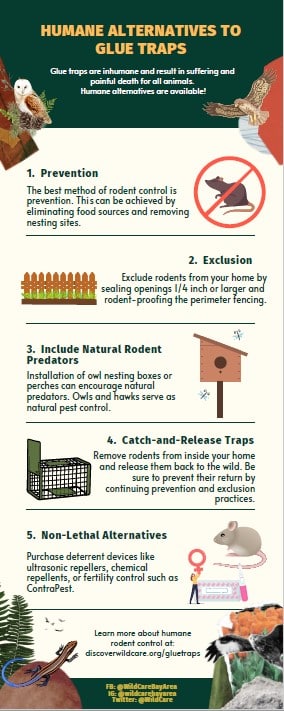
- The best method of rodent control is prevention. Rodents tend to set up camp in our homes and businesses when food and space are made available to them.
- Remove potential rodent homes like yard debris, trash, construction waste, etc. Remove ivy from on and near structures. Consider removing dense ground-covering plants too.
- Eliminate food sources. Keep your garbage completely sealed with lids closed and secured. Keep bulk food, seed, and dry pet food in metal cans with secure lids. Pick up fallen fruit. Take birdfeeders inside at night.
- Exclude rodents from your home. Seal openings 1/2 inch or larger around the outside of your house with metal, concrete, or Stuf-fit Copper Mesh Wool, which can be found online or at hardware stores.
- Include natural rodent predators in your solution. A family of five owls can consume up to 3,000 rodents in breeding season. Placing a nest box to encourage a family of owls to make your property home can be a great alternative to commercial pest control methods. DO NOT erect an owl box if you or anyone in your neighborhood is using poison, however. Please visit www.hungryowl.org for more information.
- Use catch-and-release traps as a safe, sanitary, and humane solution. Catch-and-release traps will allow you to remove rodents from inside your home, but you must prevent their return by sealing entrance and exit holes and removing attractants (see above). Remember it is illegal in the state of California and cruel to relocate animals (click to learn why), so trapped rodents should be deposited outside once entry points have been sealed.
Black Rats may establish nests in bamboo, ivy, palm trees, yucca, pampas grass, honeysuckle, blackberries, cypress, jasmine, juniper and other heavy shrubbery or thickly matted plants. Wood and lumber piles, storage boxes and sheds frequently provide shelter and safety.
Norway Rats may live in burrows along outside walls of homes, holes under shrubs or vegetation, and under the edges of sidewalks or patios. These nocturnal, opportunistic foragers are attracted to pet food, fallen bird seed from feeders, and fruit fallen from trees.
Garden problems almost always involve food and water sources. In most cases, solutions to these situations are often very simple. Learning what is attracting rodents and eliminating access to food will help solve the problems.
Rats and Rodenticides
Rodenticides, even though they are available for purchase everywhere, are dangerous poisons that can cause secondary poisoning in the beneficial species that prey upon rats. Hawks, owls, bobcats, raccoons, skunks and other carnivores all depend on rodents for food. These wild predators, and even pet cats and dogs, are in danger of being poisoned by these toxic, unnecessary products. Rodenticides are also ineffective, because rats breed too quickly to be managed by poisoning.
Rat Control
Killing rats outdoors rarely solves a rodent problem, because if the attractions remain, more rats will take the place of the killed rodents. It is not possible to eliminate all rats from the environment, but they can be controlled. Keeping your home and garden unfriendly to rats will allow their natural predators to keep rodent population numbers in balance. As described above, excluding rodents from your building, sealing their access points, and eliminating any rats trapped inside are the only long-term solutions.
Rats and Traps
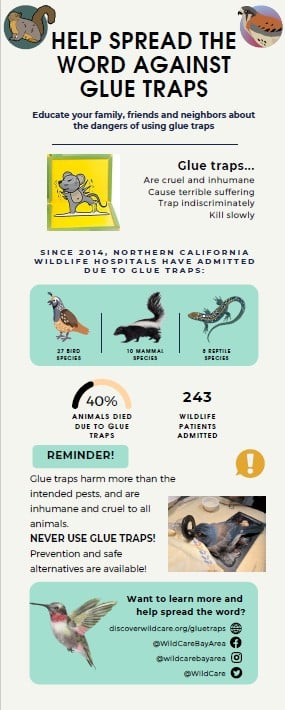
Glue traps, like poisons, kill indiscriminately and are incredibly cruel and inhumane means of death. Small birds, reptiles and non-target mammals are all attracted to the traps for the same reason the rats are. Once stuck to the glue trap, the animal slowly dies of dehydration and starvation, often injuring itself with struggles to escape the sticky trap. Learn more about why you should NEVER use glue traps here…
Snap traps, used correctly as part of a professional exclusion program, deliver a fast, humane death, and are WildCare’s recommended method for use indoors if necessary. Like glue traps, snap traps used outdoors are dangerous to many species of non-target birds and animals, especially young ones. Rats establish runways along walls, and are very wary of new things in their environment. Dead rats should be removed from traps immediately, because any live rats will avoid an area where they see another rat has been killed.
Exclude the Intruders
Many wild animals will take advantage of a rodent’s opening in a warm, dry house. To protect your home, the most humane option is also the best one for your resale value. Clean up and repair your property so rodents can’t get in. Now is a good time to do it – before you have a problem.
WildCare receives hundreds of calls on our Living With Wildlife Hotline from people looking for advice on how to rid themselves of rodents. Our best answer is always the same: exclude them from your home and remove the food source that is attracting them.
If you have questions or problems about damage in or around your home, we can help. Call the Living With Wildlife Hotline at 415-456-7283.
LIVING WITH SKUNKS
When Love Is Literally in the Air…
January through March are the months when carnivores like bobcats, raccoons and skunks seek mates. Hearing the vocalizations that bobcats or raccoons make when they mate, you might think the animals are attempting to kill each other. And a skunk’s quest for love includes another very obvious component – perfume!
Male skunks begin to roam widely at this time, often leaving their own territories in search of a mate. During this time, the males are very excitable and may spray more readily. Between these territorial disputes, males fighting and females spraying males they don’t approve of, a lot of skunk odor is generated in early spring. WildCare fields a lot of calls during this time from concerned homeowners who fear they are developing a skunk “problem.” They usually aren’t.
Odor is not always a reliable indicator of the presence or absence of skunks. Especially in this season when skunks are at their most active, you may smell their eye-watering musk and be convinced that the animal is right under your house, when in fact a dispute over a mate in the next backyard is the source of the stink.
Identifying the Culprit
Skunks dig holes in lawns, golf courses and gardens, as do several other species of animal. Digging done by skunks normally appears as small, three- to four-inch cone-shaped holes or patches of upturned earth. Long claw marks may be visible.
Skunks hunt by scent and use their long front claws to dig up beetle grubs, earthworms, roots, and fungi in the soil and under dead leaves. Skunks don’t climb well, but they will eat fallen nuts, fruit and bird’s eggs, along with pet food and anything that smells good in the trash can after raccoons have tipped it over. Field and house mice are regular and important items in the skunk diet, particularly in winter.
Skunks become a “nuisance” when their burrowing and feeding habits conflict with humans. They may burrow under porches or buildings for shelter or for a place to have their young and keep them safe until the babies are able to travel.
Exclusion
In winter, or when you are absolutely certain that not adults or babies will be closed in, you can prevent skunks from denning under buildings by sealing off all foundation openings. Cover all openings with wire mesh, sheet metal, or concrete. Bury fencing 1 1/2 to 2 feet in areas skunks can access by digging. Seal all ground-level openings into poultry buildings and close doors at night. Use tight-fitting lids to keep skunks out of garbage cans.
Properly dispose of garbage or other food sources that will attract skunks. Debris such as lumber, fence posts and junk cars provide shelter. Skunks are often attracted to rodents, so poison-free (!) rodent control may be the first step to solving a skunk problem.
Click for WildCare’s useful 24-point Self Home Inspection to help you make sure your home won’t attract denning skunks or other wildlife.
Repellents
There are no registered repellents specifically for skunks, but lights and sounds may provide temporary relief from skunk activity. Most mammals, including skunks, can sometimes be discouraged from entering enclosed areas with ammonia-soaked cloths, however remember to never place ammonia or other chemicals in an enclosed space- the fumes can be fatal to animals. However, repellents are only a temporary measure. Permanent solutions require exclusion, for which you should always hire a professional. Call WildCare’s Living with Wildlife Hotline for advice and assistance: 415-456-7283.
About that scent…
If cornered by a persistent attacker, the skunk will arch its back, raise its fur and stick its tail straight up into the air. This makes the skunk appear to be bigger and more ferocious.
Before he sprays, a skunk may also stamp his feet as a warning. As a last measure, the skunk will turn his face and tail toward the attacker, in a sort of U shape, and shoot streams of oily spray from glands on either side of his anal area. This fluid can burn the eyes and nose of the attacker and even cause nausea.
Skunk smell cannot be washed off with tomato juice, ammonia or gasoline. These just mask the odor.
A suggested treatment for odor removal is:
1 quart 3% hydrogen peroxide
¼ cup of baking soda
1 teaspoon of liquid soap
The peroxide and baking soda neutralize the odor; the soap removes the oil that holds the smell. Be careful, though. This solution may bleach hair and other materials.
LIVING WITH YELLOWJACKETS
The aggressive wasps known as Yellow Jackets are carnivorous, and can be menacing creatures when it comes to a showdown over the picnic table. They are often mistaken for bees, and sometimes are even called “meat bees,” but wasps are more closely related to ants than to bees. In the late summer and fall, their populations increase to full colony production levels.
western yellow jackets
These social hunting wasps (Vespula pennsylvanica) are responsible for most stinging incidents. Their mouthparts are well-developed with a proboscis for sucking nectar, fruit and other juices, and strong jaws called mandibles for capturing and chewing insects. Barbecued meat with sweet sauce is a prize! Unfortunately for us, these insects are just as likely to try to saw off a piece of your flesh as they are to sting you. If they do sting, they don’t leave a stinger, so they can sting repeatedly.
Like other social wasps, Yellow Jackets establish a new colony each year, which they abandon completely in the fall, when all but a few fertilized queens die off. These queens find a secure place to become dormant over winter, then revive in spring to establish their new colony.
The queen begins a paper nest from masticated wood pulp, and conceals it in an abandoned underground nest, in trees, shrubs, or in protected places such as inside human-made structures. Here she lays her eggs to produce the workers that will enlarge the colony.
From spring to mid-summer nests are in growth phase, and the larvae require large amounts of protein, all supplied by the workers. They seek other insects, and scavenge protein-rich foods. By late summer the colony grows more slowly, and workers seek sugar to maintain the queen and the other workers.
controlling Yellow Jackets.
Yellow Jackets seldom sting when they are foraging, unless they are threatened or squashed between clothing and skin. They are likely to attack when their nests are disturbed by a direct blow or by vibrations, so control should involve an Integrated Pest Management (IPM) approach using non-toxic products, avoidance, prevention and care.
Using pesticides to control Yellow Jackets is not recommended. Not only are pesticides harmful to the environment, but to be effective, the entire Yellow Jacket colony, and sometimes multiple colonies, must be located and destroyed completely. Poisons can rarely reach an entire nest.
Spraying a mix of peppermint oil, dish soap and water at the mouth of the Yellow Jacket nest can work to deter them.
For more information about Yellow Jackets visit:
• Our Water Our World
• Bio-Integral Resource Center
• One Green Planet
GLUE TRAPS ARE A BAD IDEA
How Glue Traps Actually Work
WildCare’s goal has always been to stop the use of these incredibly inhumane devices by raising public awareness, and working to get them banned in San Francisco, Marin and ultimately California and beyond.
Glue traps may sound like a good idea. Advertising for these products implies that they are clean, non-toxic and effective. Many products feature cute cartoons of stuck rodents. The manufacturers imply that all you have to do is uncover the sticky plate, put it where mice and rats have been seen and somehow the problem is solved. People don’t think about what happens next.
What happens next is horrific.
The glue trap doesn’t instantly kill the animal – the glue is not toxic. Instead, the animal stays stuck, dying over the course of several days from starvation, dehydration and suffocation.
WildCare admits a dozen or more animals stuck to glue traps every year, and each one is heartbreaking. Animals stuck to glue traps will rip off their own skin and fur trying to escape. They will even chew off their own limbs in a desperate attempt to get away. They inflict terrible injuries on themselves, even fracturing limbs, trying to get free. Trapped animals suffer for days as they slowly suffocate and starve.
Without exception, every person who has rushed to WildCare’s Wildlife Hospital with an animal stuck in a glue trap that they set has expressed deep regret. Each person says that, had they known how intensely the trapped animal would suffer, no matter how despised that animal may be, they never would have used the product.
What do you do if you find an animal stuck to a glue trap?
NEVER try to remove the animal on your own. Bring him immediately to WildCare or your local wildlife care center.
Call our Hotline for support 415-456-7283.
Keep the animal in a dark box (with air holes) to reduce his vision and stress levels and stop his frantic attempts to escape.
Never cut feathers, skin or limbs, and do not use oil to try to remove the sticky substance. Too often, well-intended rescuers use oil to remove the sticky glue, not realizing that oil ruins a bird’s waterproofing and his ability to fly. An oiled bird will likely suffer hypothermia, or die from predation or starvation because he can’t fly.
At WildCare, we always give birds ample time to preen and rebuild their waterproofing before we release them.
How to Control Rodents Humanely (Click here for a PDF of this information)
People put out glue traps because they see rodents and want them gone. Rodents inside the home should be evicted and excluded, but remember that rodents outside are part of the natural environment. Traps of any variety should never be placed outside.
The best method of rodent control is prevention. Rodents tend to set up camp in our homes when food and space are made available to them. How can you get rid of them?
Remove potential rodent homes like yard debris, trash, construction waste, etc. Rodents also thrive in groundcover like ivy, so removing ivy from the yard, especially around the house, is a good solution too.
Eliminate food sources. Keep bulk food, seed, and dry pet food in metal cans with secure lids. Pick up fallen fruit. Sweep under birdfeeders and take them inside at night.
Exclude rodents from your home. Seal openings 1/4 inch or larger around the outside of your house with metal, concrete, or Stuf-fit Copper Mesh Wool, which can be found online or at hardware stores. If you would like humane, professional assistance with rodent exclusion, contact our Living with Wildlife Hotline at 415-456-7283.
Include natural rodent predators in your solution. A family of five owls can consume up to 3000 rodents in breeding season. Placing a nest box to encourage a family of owls to make your property home can be a great alternative to commercial pest control methods. Please visit The Hungry Owl Project website for more information.
Use catch-and-release traps as a safe, sanitary, and humane solution. Catch-and-release traps will allow you to remove rodents from inside your home, but you must prevent their return by sealing entrance and exit holes and removing attractants (see above).
If you exhaust all the above efforts and as a last resort decide that lethal control of rodents is necessary, please use a rat zapper or snap traps (but only for inside use).
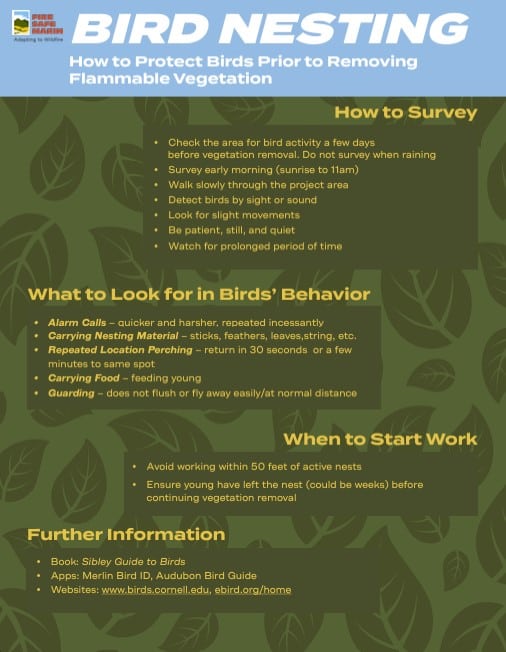
TRIM TREES FOR FIRE SAFTEY - AT THE RIGHT TIME
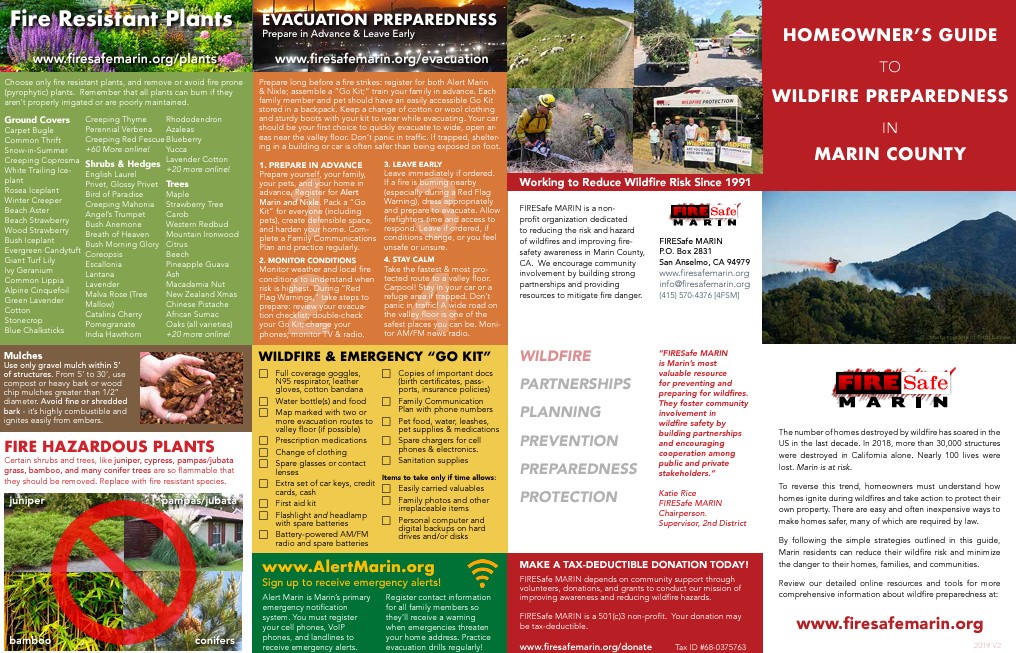
Cutting, pruning and removing trees and vegetation during nesting season is one of the primary reasons baby animals become orphaned and end up at WildCare, but a wildfire whipping through your neighborhood would cause much more damage to wildlife families (and yours!) than pruning and cutting could. For this reason, WildCare absolutely supports efforts to reduce fire risk in neighborhoods.
But we strongly encourage you to complete those wildfire safety projects BEFORE Wildlife Baby Season starts in earnest.
By completing wildfire prevention work between November and February, you can avoid disrupting wildlife while increasing your property’s resilience to wildfire risk.
Benefits of Early Action:
- Improves Safety: Proactively addresses hazards like flammable vegetation and overhanging branches before peak fire season.
- Protects Wildlife: Prevents disturbances to nesting birds and mammals, the majority of which start raising young in March or April.
- Some species start nesting in January and February, but work is possible if done with care. Don’t wait till spring, which is the peak nesting season for a majority of local wildlife
YOU Can Help Prevent Fires and Help Wildlife!
Remember that doing the work to prevent the spread of wildfires through our region will help wildlife, but when you do this work matters too.
Our Wildlife Hospital usually admits our first hummingbird patients in January or February, and our first baby jackrabbits often arrive this month too. We’ve even admitted neonate baby squirrels in January.
KEY STEPS FOR PROPERTY OWNERS:
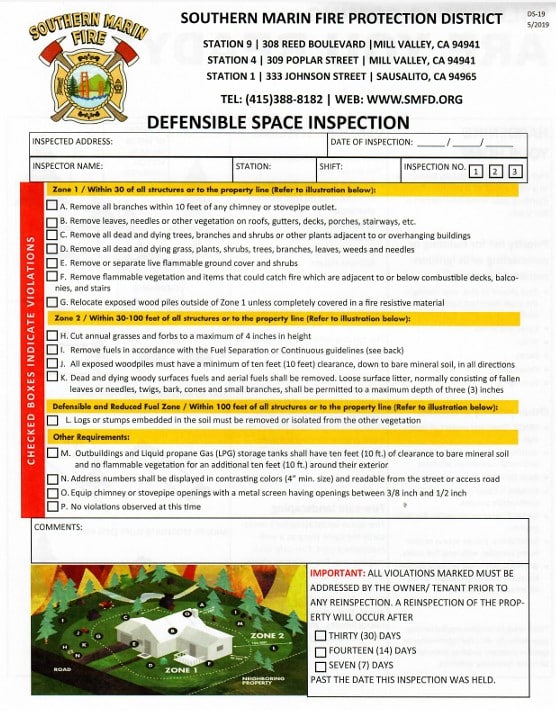
1. Review resources to create a defensible space around your property
• Check with Fire Safe Marin or National Fire Protection Agency (NFPA)
2. Check for nesting wildlife
• Look for signs of nesting wildlife before trimming trees or clearing brush. See dropdowns for species-specific information.
• If you spot nests or active wildlife, avoid those areas and call WildCare for guidance
3. Take action before spring to prune trees, clear vegetation, and create a defensible space:
• Remove dead or overhanging branches, dry grasses/brush, and any flammable materials to maintain defensible spaces.
• Implement any other recommendations from your local fire department specific to your property.
4. Remember that fire preparedness (and wildlife awareness!) is a year-round effort:
• Major pruning and vegetation removal are best done from November to February to reduce the risk of harming nesting wildlife, but ongoing maintenance in the summer is critical as grass dries out and shrubs regrow.
• Summer is ideal for maintaining defensible space in Zone Zero (within 5 ft of the home) and making structural upgrades to reduce ember vulnerability. A house-out approach-starting with defensible space closest to the structure and ensuring the home is ember-resistant-is the most effective way to reduce wildfire risk with minimal impact to wildlife. (Information from Fire Safe Marin)
• WildCare admits most of our baby animal patients between April and August, but we can admit baby wildlife as early as January and as late as November. Always check for wildlife before doing work, and please call WildCare’s Hotline at 415-456-7283 with questions.
If you have questions about potential nesting activity in your yard before you start the recommended wildfire prevention work, please call WildCare’s Hotline at 415-456-7283!


SHOULD YOU PROVIDE WATER FOR WILDLIFE?
SONGBIRDS, CATS & CATIOS
Reversing the CATastrophe
by Melanie Piazza, WildCare Director of Animal Care
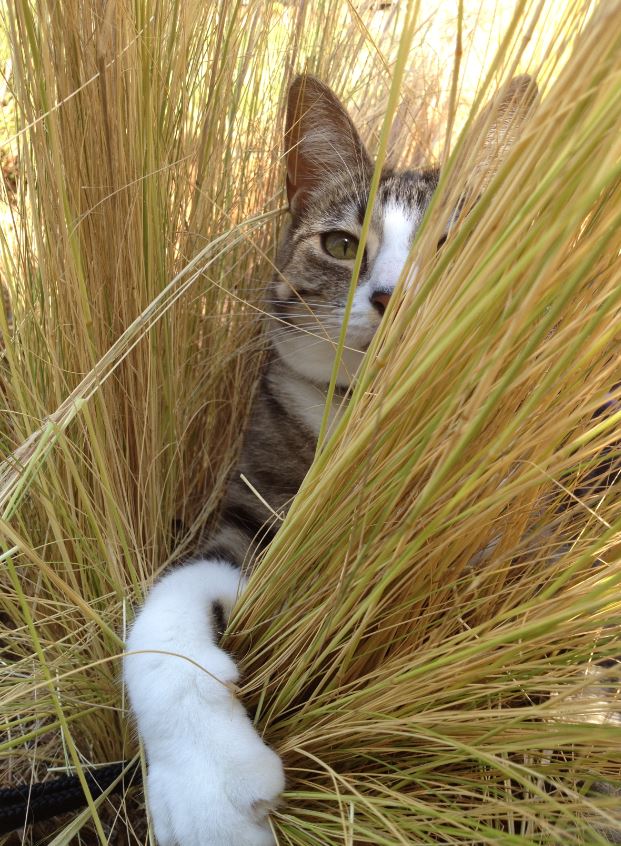
Domestic cats were bred to hunt rodents, that’s why they were domesticated. That hunting instinct is very powerful. In this photo you can just see the leash and harness this cat wears while enjoying supervised (and hunting free!) play in the yard. Photo by Melanie Piazza
I grew up in an animal-loving family. Our cats were always indoor-outdoor. It’s just what you did back then. Of course my family’s cats hunted, and I can recall as a child searching the yard with my little sister for bird feathers, skulls and wings – the remnants of unfortunate victims of our cats. It never occurred to us, back then, that this was unfair to wildlife, and preventable by keeping the cats indoors.
I also remember losing two cats to the traffic on the busy road behind our neighbor’s house. We would bury them in our pet and wildlife graveyard in the backyard, all of us sobbing for another beloved companion lost. Again, it never occurred to us that this was unfair to the cats, and preventable by keeping them indoors.
a new perspective
In 1998 I started working for an animal shelter / vet clinic and wildlife rehabilitation hospital. I saw more hit-by-car, lost-a-fight-with-something-now-dying-of-infected-wounds, and suffering cats, both owned and stray, than I had ever imagined. I also discovered something I had not thought about since my childhood – an endless flow of injured, maimed, orphaned wild animals caught by cats.
There are countless studies and reports attempting to quantify just how many wild animals free-roaming domestic cats kill each year. The most impressive study I have seen so far is ongoing, and being conducted by National Geographic and the University of Georgia. This study put cameras around cats’ necks to record their actions outside the home. Cat guardians who were in denial about their cat’s death count were shocked to see the truth, and scientists gathered invaluable information. You can learn about it at: http://www.kittycams.uga.edu/
from our own experience
At WildCare alone we treat roughly 500 wild animals a year that have been the victims of cat attacks. This number encompasses not just birds, but mammals, reptiles and amphibians as well. And these are only the animals that cat owners find alive and bring to us. Regardless of where you stand on the topic, the number of wild animals that free roaming cats kill, injure and orphan is staggering, and is putting many of our wild species at risk. Any wildlife rehabilitator can tell you how maddening and heartbreaking it is to treat or have to euthanize the never-ending flow of mangled and suffering animals that are caught by well-fed and well-loved cats year after year.
Addressing this topic puts WildCare in a challenging position. We are grateful to be available to give these animals the medical care they need and the second chance they deserve, so we are thankful for the rescuers who bring them to us. We work hard to be mindful of walking the balance of not offending cat guardians because we want everyone to feel that they can bring wildlife in need of assistance to us, and we love cats too! But as wildlife advocates we must have conversations with those whose cats have caused damage (especially repeat offenders), in the hope of changing human understanding and behaviors. I wish someone had taught me about this years earlier!
cats and hunting
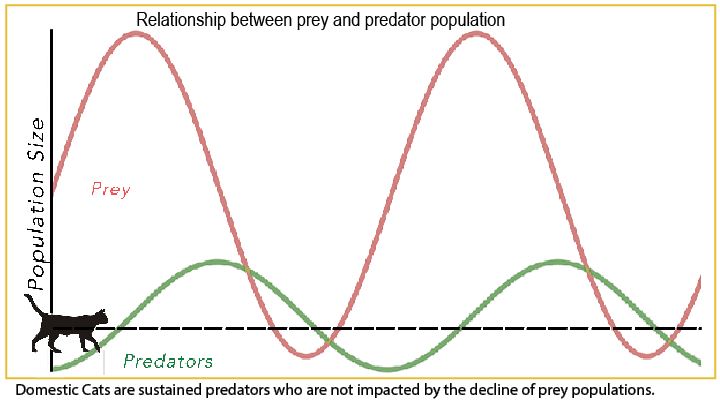 It is obviously a natural instinct for a cat to hunt. What is not natural is that our cats are domestic animals introduced into a wild food chain.
In the wild, when a local prey population, of, say, rabbits, grows large in number, the local predator population, let’s say hawks, grows as well. More hawks may move into the area, and all the well-fed hawks have more young. As the predator population continues to grow, they gradually reduce the prey population. With less food available, some hawks starve and die, some are forced to move out of the area in search of food elsewhere and their own breeding is not as successful. During this downswing in hawk numbers, rabbits have a chance to repopulate. The prey population recovers so well that eventually the predator population booms again. This cycle is repeated over and over.
Now introduce domestic cats. Cats are housed and fed by their guardians, their every need taken care of. They can live up to 20 years in the same territory. There are multiple cats in the area and more are added every year. Nothing brings cat populations down. Cats don’t need to hunt to survive, but do it for fun. Prey animal populations never have a chance to recover.
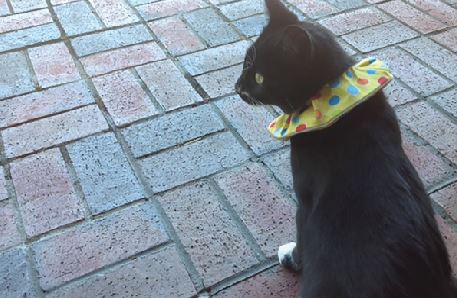
Dan the Cat wears a Birdsbesafe collar, purchased by his guardian when she brought an injured bird caught by Dan to WildCare.
Another common argument is that wildlife should evolve to be able to avoid cats. If they do not, they “should” be taken out of the gene pool anyway. In truth, evolution is the result of
species evolving side-by-side over untold years, affecting each other in the process. Wildlife cannot evolve fast enough to respond to a domesticated species. Free-roaming cats killing wildlife is, in fact, an unfair and unnatural situation from which many species cannot recover. Another point to make about the “food chain” that is important for pet guardians to realize, is that once you allow your pet outdoors unprotected, natural or not, they have entered the food chain where not only can they hunt, but they too can be hunted.
The best news regarding the topic of free-roaming cats and wildlife is that the carnage is preventable! There are many resources online to teach you how you can slowly acclimate your free-roaming cat to an indoor life and/or how you can keep an indoor cat happy and healthy. Just this short google search brought up an array of good resources.
a better alternative
A lifetime of lessons later, my personal favorite compromise lets me keep both wildlife and my cat safe, and still offers my feline friend the fresh air and sunshine she loves – the CATIO! A catio can be any size, shape or configuration to fit your house or apartment and just about any budget. From something as simple as a window box to a screened-in patio area with multiple level pathways, your imagination is the limit. You can build your own or purchase prefab kits. There are numerous photos in this article of catios belonging to WildCare staff members and volunteers (including my own) and you can also find more ideas online.
And in a final note, I realize that some cats will not adjust to being kept indoors. They will yowl non-stop, shooting outside at any chance. If this is your cat, then the best we can ask is that you do everything in your power to mitigate the damage that he or she can do.
Here are some ideas:
• Utilize online resources that will teach you how to slowly acclimate an outdoor cat to an indoor life.
• Do not allow cats outdoors during dawn and dusk when wildlife is most active, both for your cat’s and wildlife’s safety.
• Harness and leash-train your cat for supervised walks.
• Try products such as The Cat Bib and BirdsBeSafe collars.
Note: Bells do not work. Cats learn to walk without ringing them and fledgling birds that cannot fly still cannot escape, even if they hear the bell. If you see a fledgling in your yard, please keep your cat indoors for the few days this baby bird will need to learn how to fly.
“if not this cat, then the next”
“If not this cat, then the next” is a great message from an amazing (if unlikely) coalition between the Audubon Society of Portland and the Feral Cat Coalition of Oregon. For those who currently have an adult cat for whom all attempts at keeping indoors have failed, we encourage you to make the pledge that the NEXT cat(s) you adopt will be indoor only.
These two organizations have joined forces in an attempt to reach more people who disagree on the topic of free-roaming cats and their impact on wildlife. By bringing together both cat and wildlife lovers, they hope that more people will be open to conversations and suggestions from both sides, which is what WildCare strives for as well.
List of Catio and Cat Enclosure Resources
This list is provided as a resource and does not imply endorsement by WildCare.
- The Cat’s Den: Commercial kits for indoor and outdoor cat runs and enclosures.
- Purrfect Fence: Commercial kits and instructions for free-standing cat fence systems. Also offers professional installation in certain regions. And now offering “Cat-Proofer” system for converting existing fencing to make it escape-proof.
- C & D Pet Products: Commercial kits and diagrams for enclosures available in various sizes and prices. Also offers kitten enclosures.
- Kritter Kondo
- Safe Cat Outdoor Enclosure: Detailed drawings and descriptions to create custom outdoor enclosures for cats and other small animals.
- Kitty Walk System, Inc.: Various commercial enclosures for cats and other small animals. Most enclosures are preassembled, portable.
- SunCATcher Enclosures: Free-standing outdoor cat enclosures for yard or patio.
- CatsOnDeck: Modular indoor/outdoor cat enclosures. Expandable and portable for RV use.
- Wild Whiskers: Portable, light-weight, non-permanent cat enclosures.
- https://catiospaces.com – catios and cat enclosures to keep your cat safe
- https://www.catster.com/lifestyle/cat-house-catio-diy-how-to-design-build – blog post around building a DIY catio
See also The Cat Bib and BirdsBeSafe collars.
UNDERSTANDING COYOTE DENNING BEHAVIOR
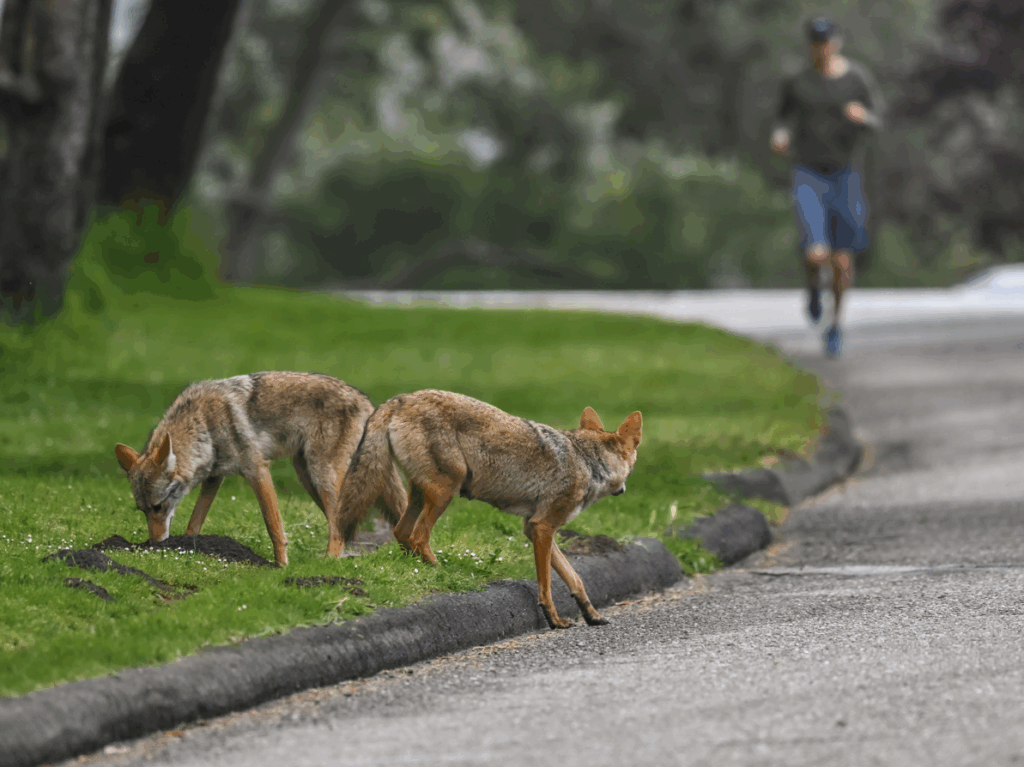 Coyotes in the Park with a Jogger, by Robert Ho. Article by Janet Kessler
Coyote pupping season lasts from approximately February through the fall, and during this time, protective coyote parents are very concerned about the safety of their family.
The main point to understand about coyote denning behavior is that it is protective territorial messaging behavior, not unprovoked aggression, although that is how it might appear.
Coyotes have ONE thing that is precious to them: their pups.
Coyotes’ whole social system and territoriality is geared for successful raising of their litters. There is just one coyote family in any territory, which, in San Francisco, measures about two square miles. Coyotes’ territorial behavior is geared to keep other coyotes out of their exclusive territory, which provides the food they need to sustain themselves and to raise their young successfully.
Coyotes are pretty successful at keeping other coyotes out; however, wolves, mountain lions and even dogs and their owners are constant problems for them. And it’s dog owners who often walk their dogs into coyote areas in the first place, knowingly or unknowingly. For the safety of your pets and the coyotes, we encourage you to learn what to expect and what to do if you encounter a protective denning coyote.
Dens and Den areas
There are approximately 17-20 coyote territories in the city of San Francisco, each with one alpha male/female pair of coyotes who may or may not have produced a litter of pups in any particular year. See map here.
The actual den is used only temporarily for the actual birth of the pups and several months thereafter. Then – as with bird nests or our own bassinets – the young pups outgrow the den, and the family will abandon it to sleep outside, usually in hidden and protected places.
Dens might consist of openings under trees or rocks (which could be expansions of pre-existing burrows of other animals), they may be dug from scratch, or coyotes may even make a den under a porch or other human habitation.
Coyote pairs usually dig multiple dens in their territory – not just one – most of which may never be used. Pups may be moved between several dens several times in the first few months of life, usually for safety reasons or possibly due to a flea infestation. I’ve seen pups rotated between dens at one month after birth, at six weeks, and again at three months of age.
One of the coyote families I know gave birth within one of the water reservoirs, but within six weeks they moved those pups. Why? Apparently the holes under the fence which they used for access were being closed-off/plugged-up because of construction work and the parents must have feared eventual complete blockage of their escape routes.
After about four months of age, coyotes generally shuffle through wider and wider areas, and of course, the pups are roaming and exploring more and more as time moves on. By the time the pups are four months of age I’ve spotted some as far away as a mile from their birthplace.
It’s important to understand that coyote den protecting behavior extends FAR beyond the immediate den itself – 1000 feet or more.
The protected area is not just the immediate area around the den. It covers a large playing field within the territory where the pups will eventually be exploring and hunting – half a mile to a mile from an actual den is not an exaggeration.
WHO might the coyotes target with their protective den behavior?
ANY dog may become a target for being messaged, no matter the dog’s size. A coyote may even approach a dog without provocation, “just as a precaution.”
Coyotes approach to message their warning to “get away” and “be aware of me.” These animals are very concerned about potential and perceived threats to their pups, but they are smart and self-protective about it: they feel most comfortable approaching beings their size or smaller, and they may be more likely to approach a smaller or more mellow dog for this reason.
Unfortunately, small children can also fall into this category-they are seen by coyotes as small, unthreatening and mellow, so the coyote feels safe approaching. Small children should be supervised closely in coyote areas. Also be aware that small pets – primarily cats – may be grabbed by coyotes. Coyote nutritional needs skyrocket during pupping season, so they may grab any potential prey that opportunistically appears in their path. This is one of the reasons WildCare encourages keeping cats indoors.
What protective den behavior entails

Remember that coyotes just want to be left alone, but they’ll be extremely protective of their pupping areas. You’ll notice in the photo that this mother is jumping around angrily with hackles up and a snarly face. She is also likely screaming piercingly and angrily.
The screaming doesn’t occur as often as the posturing behavior seen in the still images, but growling can occur, and ultimately, if the message is not heeded, short charges towards and a nip to the dog’s back legs or haunches may result, cattle-dog-fashion, to get the dog to leave.
WHY TRAPPING DOESN'T WORK
Trapping doesn’t solve a nuisance animal problem.
If your property provides food, water or shelter, animals will find it.
If you borrow a trap or hire a trapper to trap and remove an animal that has moved into a cozy den space under your deck, or one that eats your cat’s leftover food, you are then leaving an attractively open space (or an easy food source) on your property for the next wild creature that comes along. You can trap that animal too, but what about the next one?
Unless whatever is attracting the animal is removed, other animals will fill the vacant space.
When you hire a pest control company to come out and trap a nuisance animal, or if you do it yourself, legally the animal must be released within 100 yards of the capture site, or the animal must be killed- AND trappers are not legally required to tell you this. That’s right. California law requires trappers to release a trapped animal essentially back on your property, or to euthanize the animal.
Sometimes trappers try to hide this fact but telling clients they will relocate the animal to some green and healthful spot. While this may sound like a good option, keep in mind that it is not legal for a trapper (or anyone) to relocate, so most likely he is lying to you and will instead kill the animal. Also keep in mind that relocation is actually incredibly cruel.
In the vast majority of cases, relocation results in the death of the animal. Imagine an animal removed from its den, comfort zone and all its known food and water sources. Imagine dropping that animal, confused and terrified, into another animal’s territory. What is likely to happen? The relocated animal will be beaten up and chased away, and will eventually starve to death, or die of exposure. In this situation, most wildlife will perish. Most of the problems people have with wildlife happen during spring and summer’s baby season, so trapping often separates a mother from her dependent young, leaving them behind to die from starvation, dehydration and hypothermia. Relocation of nuisance wildlife is never a good option to solve a wildlife problem.
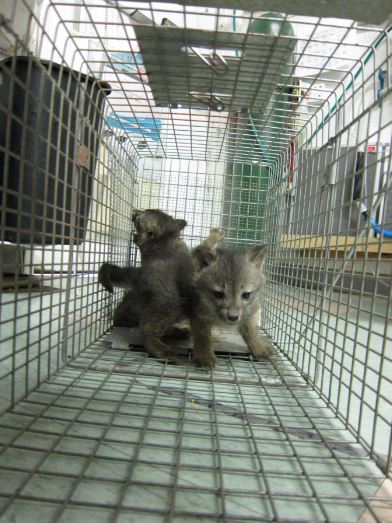
Solving nuisance wildlife problems humanely
WildCare works with concepts known as “humane eviction” and “humane exclusion.” Humane eviction means that you use information about wildlife behavior and natural history to motivate the animal(s) to leave on their own.
Humane exclusion means that you remove what attracts the animals to your property.
Again, animals are drawn to your property because it offers food, water, or shelter. Removing a food source (pet food set outdoors, seed falling from a birdfeeder, fallen fruit) excludes and evicts animals, because it encourages the animals to move on in search of other food sources.
Closing up a den site is also a type of exclusion, although great care must be done to make sure that no animals are trapped inside before an entry point is sealed. ALWAYS call WildCare’s Living with Wildlife Hotline for advice before attempting to close an animal’s entry hole. Trapping an animal inside is cruel and inhumane, and a trapped animal may cause considerable damage in attempts to escape.
Trapping doesn’t work and is cruel. Choose the humane, and ultimately most effective method for dealing with nuisance wildlife — eviction and exclusion.