
Migratory Songbirds and Windows
Migratory animals face an incredible number of hazards, especially the smallest of avian migrants, the songbirds. Hermit Thrushes, like the bird in this photo by Michael Pagano, are comparatively short-distance migrants, but they still face a dangerous journey, especially when they pass through populated areas like the Bay Area. Our area sees a jump in the number of Hermit Thrushes from September to April because a population of them winters here.
What To Do If a Bird Hits Your Window: Updated WildCare Recommendations
Every fall, millions of birds pass through the Bay Area during migration season, and unfortunately, many collide with windows or other man-made structures along the way. At WildCare, we see a heartbreaking number of window-strike songbird and raptor patients each migration season.

Photo by Michael Pagano
If you’ve ever had a bird hit your window and drop to the ground, you’ve probably heard advice like: “Put the bird somewhere quiet for 20 minutes and see if he perks up.”It turns out that’s no longer considered safe advice.
Why “just stunned” can still mean serious injury:
If a bird has hit something hard enough to fall to the ground or be easily picked up, that impact may have caused more serious injuries than it first appears. Even if he seems alert and flies away, internal trauma can develop hours or even days later.
According to wildlife veterinarians, window-strike birds are at risk for:
- Brain swelling or bleeding
- Fractures of the hip, leg, keel, or coracoid/clavicle
- Spinal trauma
- Eye or vision injuries
As WildCare’s own Dr. J explains, “If a bird is down long enough to be easily caught, we can’t assume he’s fine – we just can’t see all the injuries.”
What to do if a bird hits your window:
If you find a bird that has struck a window and you are within driving distance of a licensed wildlife hospital or rehabilitator, the best thing you can do is contain the bird safely and bring them in for evaluation and further care.
- Gently place the bird in a paper bag or small box lined with a soft cloth.
- Keep the container closed and in a quiet, dark, warm place.
- Do not give food or water or provide supplemental heat.
- Bring the bird to WildCare or your local licensed wildlife hospital as soon as possible.
Even if she seems fine, a quick veterinary exam and a few days of anti-inflammatory medication could make the difference between full recovery and fatal complications.
If you’re truly too far from any wildlife facility, the next best thing, as Audubon.org recommends, is to let the bird rest undisturbed in a paper bag for about an hour before checking again. If you hear the bird moving or “tap-dancing” around inside, he’s likely feeling better and may be ready to fly off.
Prevention is the best medicine!
Of course, the best way to help is to prevent window strikes in the first place!
WildCare recommends Feather Friendly® window collision deterrent kits – small adhesive dots that make glass visible to birds while remaining subtle to the human eye. They’re easy to install and remarkably effective.
Learn more about making your home bird-safe at FeatherFriendly.com or read more in this Audubon Magazine article.
Together, we can help migrating birds make it safely to their next stop along the journey.
Any bird caught by a cat, however, needs immediate medical attention, as bacteria on cats’ teeth and claws are deadly to birds, even if the injuries inflicted are small. Always bring a bird caught by a cat to WildCare for treatment with antibiotics.
Did you know that windows and domestic cats are the number one killers of songbirds?
WildCare recommends keeping cats indoors for their safety and the safety of the birds and other wildlife. For more information on keeping your cat healthy and happy indoors, click here.
Window strikes can be reduced or prevented with the following steps:
Relocate your bird feeders
Position your bird feeders, birdbaths and other attractants half a meter (1.5 feet) or less from your windows.From this short distance, birds cannot build up enough momentum to injure themselves should they hit your window. This may seem counterintuitive, but the closer the bird feeder to your window, the better for the birds and your viewing!
Placing feeders 30 or more feet away from windows will also help, if visual alerts are applied to the window.
Give the birds visual alerts
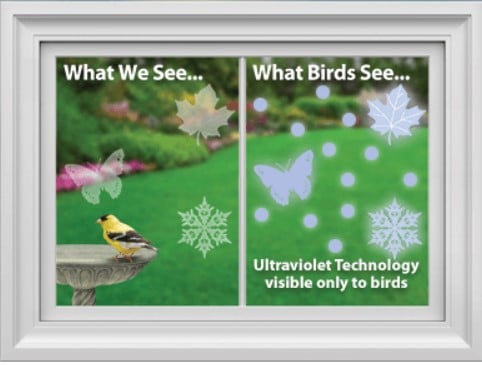
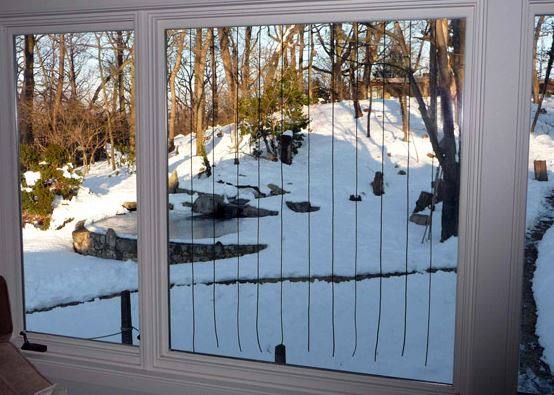
The key is to provide birds with the visual cues they need to alert them to the presence of glass.Visual markers on windows are the most effective collision reduction strategy when properly applied. Unfortunately, one or two stickers on a window aren’t effective. To properly alert birds, windows must be covered with a uniform pattern four inches apart for vertical alerts, and five inches apart for horizontal alerts.A fun option recommended by WildCare’s Birdroom Manager Lucy Stevenot is WindowAlert’s UV Liquid. If properly applied, this liquid is virtually invisible to humans from inside the building, but birds can see it. Painted-on markings must be renewed every month or two, depending on your window and weather. You can even have fun with this! You or your kids can treat it as an art project and decorate the window with the marking applicator!
Products such as Acopian BirdSavers, CollidEscape and others (see the American Bird Conservatory website for an excellent list and the Fatal Light Awareness Program (FLAP) for additional great information) also provide visual alerts to songbirds to dramatically prevent window strikes. Always hang alerts on the exterior of the windows for best results.
Move houseplants
If you can see your houseplants from the outside of your home, then so can the birds. Birds perceive your houseplants as a possible perch or refuge. Moving your houseplants back from your windows lessens this attraction.
Close curtains and blinds
Close curtains and blinds to reduce the dangerous illusion of clear passage through windows, especially those that meet at corners, or where windows are situated in line with one another at the front and back of your home.Exterior window awnings can also help mute window reflection and help protect birds from the illusion of a clear passage.Please consider these steps to make your yard safer for songbirds! So many of the injuries WildCare’s songbird patients suffer are entirely preventable. With your help, more migratory songbirds will survive their arduous migration to sing another day
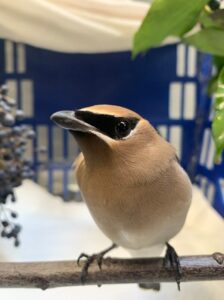
Cedar Waxwing in care at WildCare. Photo by Lucy Stevenot